Size the wired backhaul for the worst Saturday of the season, not the average Tuesday, because a stadium network is judged by a full house that arrives for four hours and then disappears. The cameras, gate readers and PA endpoints stay powered on quiet days, but the extra event-day streams, temporary media desks and roaming event crews all land on the same fiber at once, so the plant has to be built for the peak and then left idle for the rest of the year.
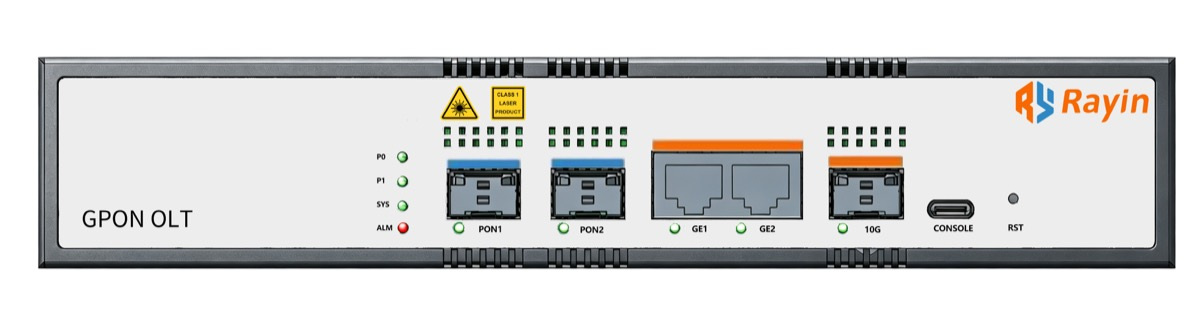
Rayin (Shenzhen Rayin Technology) is a manufacturer of GPON OLTs and industrial Ethernet switches.
Event-day load is a step change, not a gentle curve: an industry-typical 40,000-seat bowl can move from a 15 percent uplink baseline to over 60 percent once camera streams and temporary desks come online, so headroom is a design input rather than a leftover.
Distance decides the media. Copper stops at the 100 m channel limit of IEEE 802.3, while stand-side cabinets commonly sit 300-800 m from the equipment room (industry-typical), which pushes every long run onto ITU-T G.652 single-mode fiber.
The switch only owns the wired side. Wireless APs and wireless bridges belong to a separate radio system; agree that boundary on the drawing before anyone orders hardware, and keep radio coverage planning out of the switch bill of materials.
Very little in the cable plant, almost everything in the traffic. On a stadium network the quiet-day baseline is a handful of monitoring cameras and a gate reader polling at a low rate. On match day the same cabinet feeds extra camera angles, temporary press positions and a burst of gate traffic in the 90 minutes before kick-off. The fiber does not get faster; the queues at the uplink do, and the 100 m copper limit in IEEE 802.3 is the reason those long hops went optical in the first place.
| Load item | Quiet day (industry-typical) | Sold-out event (industry-typical) | Design consequence |
|---|---|---|---|
| Stand camera streams | 4-8 per stand | 12-20 per stand | Size the access switch for the peak, not the average |
| Gate-reader transactions | Sustained low rate | Bursty in the 90-minute arrival window | Leave queue headroom on the uplink |
| Temporary desks and media points | 0 | 10-30 extra copper ports per stand | Pre-wire spare ports and label them |
| Aggregate uplink use | 15-25 percent of 10 Gbps | 55-70 percent of 10 Gbps | Hold 30-40 percent back as headroom |
| Devices powered over Ethernet | Fixed | Fixed plus event extras | Recheck the PoE budget before each season |
Walk it, do not guess from the architect's PDF. A 40,000-seat bowl puts the far stand 300-800 m from the main equipment room by cable route, industry-typical, once you add the riser, the tray bends and the service loop. IEEE 802.3 caps a copper channel at 100 m, and a TIA-568 horizontal link is installed to a 90 m permanent-link limit with 10 m left for patch cords, so neither gets you across the bowl. Single-mode fiber to ITU-T G.652 covers spans of several kilometres, comfortably beyond the 300-800 m measured here, with no repeater in a damp stand-side cabinet.
One stand-side cabinet per stand, or one per two stands, fed by a pair of fibers from the equipment room, is the pattern that survives event day. The cabinet holds an industrial PoE switch, the optical uplink, patching and a small UPS. Keep aggregation out at the cabinet instead of dragging every endpoint back to the core: a 24-port access switch with two 10 Gbps uplinks collapses twenty-odd copper runs into one fiber pair. Wireless APs and wireless bridges are somebody else's scope. The switches in this design terminate the wired side only, copper to the endpoint and fiber toward the core, and radio coverage planning stays with the radio vendor. No wireless brand belongs in this document.
| Cabinet item | Typical quantity (industry-typical) | Standard or source | Why it is there |
|---|---|---|---|
| Access switch, 24 copper ports | 1 per stand | IEEE 802.3 | Aggregates camera, gate and PA drops |
| Optical uplink, 10 Gbps | 2 per cabinet | ITU-T G.652 fiber | Dual paths back to two core switches |
| PoE budget | 400-675 W per cabinet | IEEE 802.3bt, 90 W at the source | Feeds cameras and gate readers without local mains |
| Horizontal copper drop | Up to 90 m | TIA-568, by series name | Last leg from cabinet to device |
| Fiber pairs to equipment room | 2 per stand, 300-800 m | ITU-T G.652 | Distance beyond the 100 m IEEE 802.3 limit |
Add the device draw, add the event-day extras, then add a margin. IEEE 802.3bt sources up to 90 W at the power sourcing equipment, though a fixed camera rarely asks for more than 15-30 W (industry-typical). A stand with twelve cameras, four gate readers and two PA endpoints might sit near 300-400 W on paper and still need a 740 W supply once PTZ heaters and four temporary desks are counted. That arithmetic is one line of the design; the full worked version sits in the PoE power budget article linked in Related Reading.
| Endpoint | Count per stand (industry-typical) | Draw per device (industry-typical) | Subtotal |
|---|---|---|---|
| Fixed or PTZ camera | 12 | 15-30 W | 180-360 W |
| Gate reader | 4 | 10-15 W | 40-60 W |
| PA endpoint | 2 | 20-30 W | 40-60 W |
| Temporary media desk | 4 | 15 W | 60 W |
| Subtotal | 22 | - | 320-540 W |
| 25 percent margin | - | - | 80-135 W |
| Budget to provision | - | - | 400-675 W |
A PoE switch for video surveillance sits at the centre of that table, so the power figure and the port figure have to be checked together: a switch with enough watts but only twelve ports is just as useless on event day as one with twenty-four ports and a 370 W supply.
This is where a clean design gets messy. Event crews arrive after the switch is racked and ask for camera positions and desk drops nobody drew. Reserve 20-25 percent of the ports in every stand-side switch, an industry-typical figure, and pre-patch those spares to a labelled patch panel rather than leaving them as bare ports. A 24-port switch with 5-6 ports held back absorbs a normal event build without a cabinet swap. Record every temporary patch on the network topology diagram and set a date to pull it; temporary cabling that survives three seasons becomes permanent cabling nobody owns.
| Build stage | Ports used | Spare ports | Who signs the change |
|---|---|---|---|
| Handover, quiet day | 8-10 of 24 | 14-16 | Designer and venue IT |
| Event build, day -2 | 18-19 of 24 | 5-6 | Event network lead |
| Event day | 18-19 of 24 | 5-6 | Event network lead |
| De-rig, day +1 | Back to 8-10 | 14-16 | Venue IT, with patched cables pulled |
Six fields, filled in on site. Anything less and the next contractor is guessing at 02:00 on match day. The 100 m IEEE 802.3 copper limit, the ITU-T G.652 span lengths and the 90 W IEEE 802.3bt budget all belong on the sheet as measured values, not as a datasheet footnote.
| Field | Example entry | Why it is needed |
|---|---|---|
| 1. Topology as built | 6 stands, 2 cores, dual 10 Gbps uplinks per cabinet | Shows where a fiber fault strands a stand |
| 2. Fiber pair and length | Stand C, pair 3/4, 620 m, ITU-T G.652 | Makes a later OTDR trace comparable |
| 3. Port and VLAN map | Cabinet C2, ports 1-12 cameras, VLAN 20 | Turns the drawing into a usable lookup |
| 4. PoE load | 410 W measured of 740 W provisioned | Proves the budget still has margin |
| 5. Spare ports | 6 held back, patched to panel C2-S | Stops unlabelled event-day patching |
| 6. Sign-off and date | Venue IT, 2026-11-05, de-rig 2026-11-08 | Sets who updates the drawing after de-rig |
How much of the uplink should be left free on event day?
Leave at least 30 to 40 percent of the uplink uncommitted, an industry-typical margin for a sold-out event. A full house adds camera streams, gate-reader bursts and temporary media desks all at once. If your baseline already uses 70 percent of a 10 Gbps uplink, you have no headroom for that peak.
Can I run stand cameras over copper instead of fiber?
Copper stops at 100 m under IEEE 802.3, and a stand-side cabinet is often 300 to 800 m from the equipment room, industry-typical distances for a 40,000-seat bowl. Run single-mode fiber to ITU-T G.652 for those spans, then drop to copper only for the last few meters at the device.
Who handles the wireless APs in the seating bowl?
Wireless APs and wireless bridges are a separate system, handled by the radio vendor rather than the Ethernet switches. Rayin supplies the wired side only: industrial Ethernet switches and GPON OLTs. The design here stops at the copper and fiber edge, so keep radio coverage planning out of the switch bill of materials.
What is the minimum spare port reserve per stand?
Reserve 20 to 25 percent of the ports in every stand-side switch, an industry-typical figure for temporary builds. Event crews add cameras, desks and monitoring points after the design is signed, and unplanned patching across switch rows is how labelling gets lost. Spare ports cost little now and save a cabinet swap later.
Does the handover need a network topology diagram?
Yes. It is the one record that lets a contractor find a stand-side cabinet at 02:00 on match day. Show each uplink, fiber pair, VLAN and port assignment, then note who signs the update after temporary cabling is removed. A drawing that stops at the core switch is not a handover document.
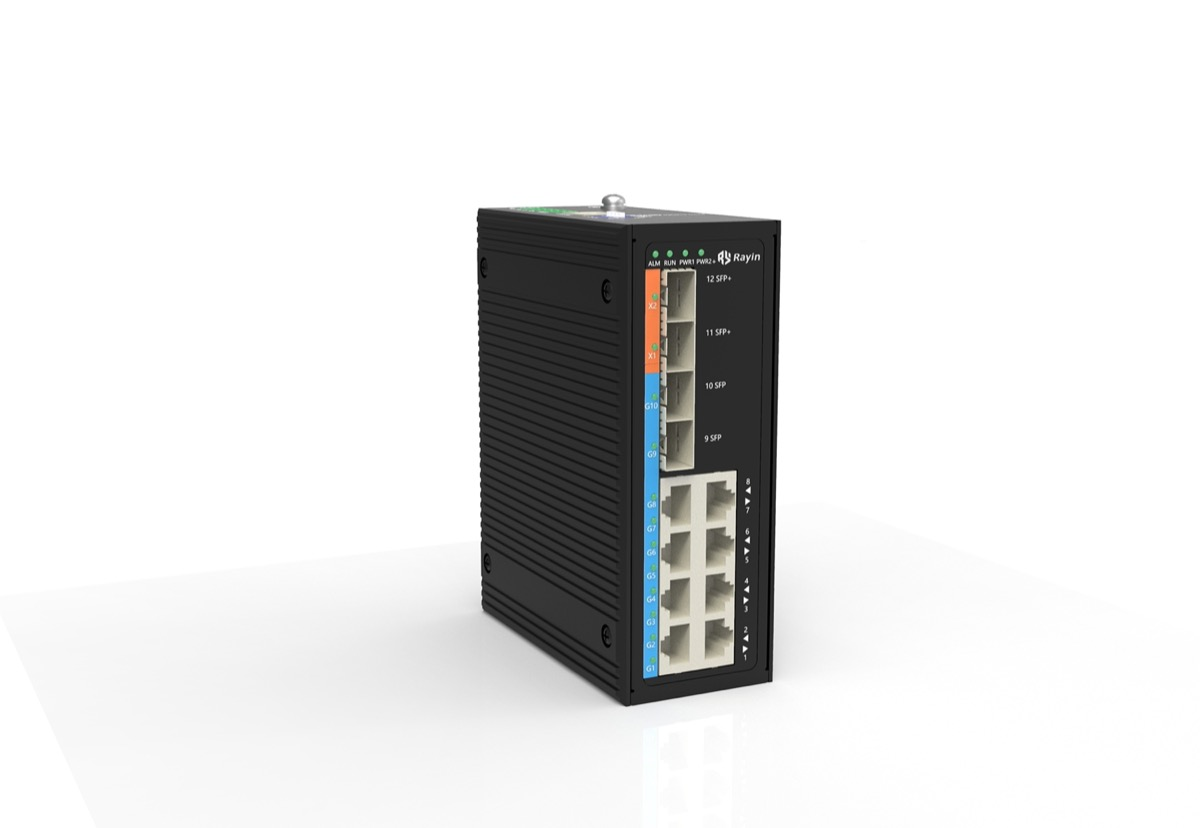
Build for the full house and the quiet days take care of themselves. Pull ITU-T G.652 fiber to each stand, land it in a cabinet with an industrial PoE switch, budget IEEE 802.3bt power for the event-day extras, and write the six handover fields down before the de-rig crew leaves. Rayin's 8+4-port gigabit industrial switch, with PoE as an option, is one fit for the smaller zone cabinets here, but the plant matters more than the part number: a 30-40 percent uplink margin and 5-6 labelled spare ports are what keep a sold-out Saturday boring.
The distance, power and cabling statements above come from public industry sources - IEEE 802.3 (the 100 m copper channel limit), IEEE 802.3bt (up to 90 W at the power sourcing equipment), ITU-T G.652 (single-mode fiber characteristics for campus-distance spans) and TIA-568 (structured cabling practice, cited by series name only). The method, worked examples and wording are written by Sara, who checked each figure against those sources before publication. Every subscriber-free seat count, headroom margin, port reserve and wattage in the tables is an industry-typical value, not a measured figure from a Rayin product; Rayin supplies wired switches and OLTs only, and the wireless APs and wireless bridges that sit outside this design are not part of its line.
About the author: Sara — Sara is a Customer Manager at Rayin with over 10 years of experience in the communications field. In her free time, she enjoys badminton and swimming.
About Rayin: Shenzhen Rayin Technology Co., Ltd. — Company Profile