One fiber carries broadband, IPTV, Wi-Fi backhaul and voice in a hospitality network by giving each service its own VLAN and GEM port on a shared passive optical network, then splitting that single strand to every room through unpowered optical splitters.
Rayin (Shenzhen Rayin Technology) is a manufacturer of GPON OLTs and industrial Ethernet switches.
A single GPON PON port registers at most 128 ONU under the ITU-T G.984 series, so one strand can reach every room on a floor without a powered aggregation switch in between.
Isolation is logical, not physical: separate VLANs, GEM ports and DBA profiles keep broadband, IPTV over PON and voice out of one broadcast domain.
A 1:128 split inserts roughly 24-25 dB of loss (industry-typical), which calls for a Class C+ (32 dB) OLT-side module; ONU-side optics stay at Class B+.
GPON puts several services on one strand by giving each a different wavelength and a different logical pipe, not by running a separate cable to every room. The ITU-T G.984 series uses 1490 nm downstream, 1310 nm for upstream bursts and leaves 1550 nm free for a video overlay; the same series fixes the line rate at 2.488 Gbps down and 1.244 Gbps up. That split matters because downstream traffic is broadcast to every ONU, while upstream is a shared time domain the OLT schedules. IPTV over PON exploits the broadcast direction: one multicast stream reaches the splitter once and is copied optically to every ONU that joined the group, instead of the head-end sending a copy per room. Broadband, voice and the wired backhaul to wireless access points are mapped into their own GEM ports and VLANs on top of the same frames. Between the OLT and the ONU the fiber is passive glass, with no powered electronics in the riser. A hotel PON is really just that: one OLT port, one riser fiber, one tree of splitters, a multi service PON by construction. The wireless access points themselves sit outside the wired plant described here, and this design stops at the Ethernet handoff on the ONU.
Sharing a fiber is not the same as sharing a network. Each service gets a VLAN and, on the PON, its own GEM port and T-CONT; the OLT then decides how much upstream time each one receives through DBA. IEEE 802.1Q defines a 12-bit VID, so 4096 VLAN IDs are available, far more than a property will ever need, and 802.1p priority bits let voice and video jump ahead of bulk downloads. Multicast is the subtle part: without IGMP snooping, a video stream floods every ONU on the PON port, so the OLT and ONUs must prune it to the ports that actually joined. The ITU-T G.984 series frames downstream traffic in 125 microsecond cycles, which is the granularity DBA works with. A multi service PON lives or dies on this mapping, so write it down once and keep it in the handover file.

| Service | VLAN | GEM port / T-CONT | Priority | Multicast handling |
|---|---|---|---|---|
| Guest broadband | Per-floor data VLAN | Best-effort T-CONT | Low | Unicast only |
| IPTV over PON | Dedicated multicast VLAN | Fixed-bandwidth T-CONT | High | IGMP snooping, one copy per PON port |
| Voice | Separate voice VLAN | Fixed-bandwidth T-CONT | Highest | None |
| Wi-Fi backhaul | Management VLAN | Assured T-CONT | Medium | Unicast only |
Every doubling of the split ratio adds roughly 3 dB of loss (industry-typical), so a 1:32 splitter sits near 15-18 dB, a 1:64 near 18-21 dB and a full 1:128 near 24-25 dB. Add fiber attenuation, splices and connectors (industry-typical: about 0.35 dB per km at 1490 nm and 0.5 dB per connector) and a worked 5 km riser lands near 28 dB total (industry-typical estimate), which is exactly why a Class C+ (32 dB) OLT-side module is the safe choice at 1:128, while ONU-side optics remain Class B+. The ITU-T G.984 series defines those optical classes; the 24-25 dB figure is the splitter alone, not the whole link. If a measured ONU receive level comes in low, weak-light troubleshooting on a PON starts with cleaning connectors and checking the splitter port before anyone blames the OLT. Keep that discipline: the budget is arithmetic, not a datasheet promise.
| Split ratio | Splitter loss (industry-typical) | ONU per PON port | OLT-side optics |
|---|---|---|---|
| 1:32 | 15-18 dB | 32 | Class B+ |
| 1:64 | 18-21 dB | 64 | Class B+ or C+ |
| 1:128 | 24-25 dB | Up to 128 | Class C+ (32 dB) |
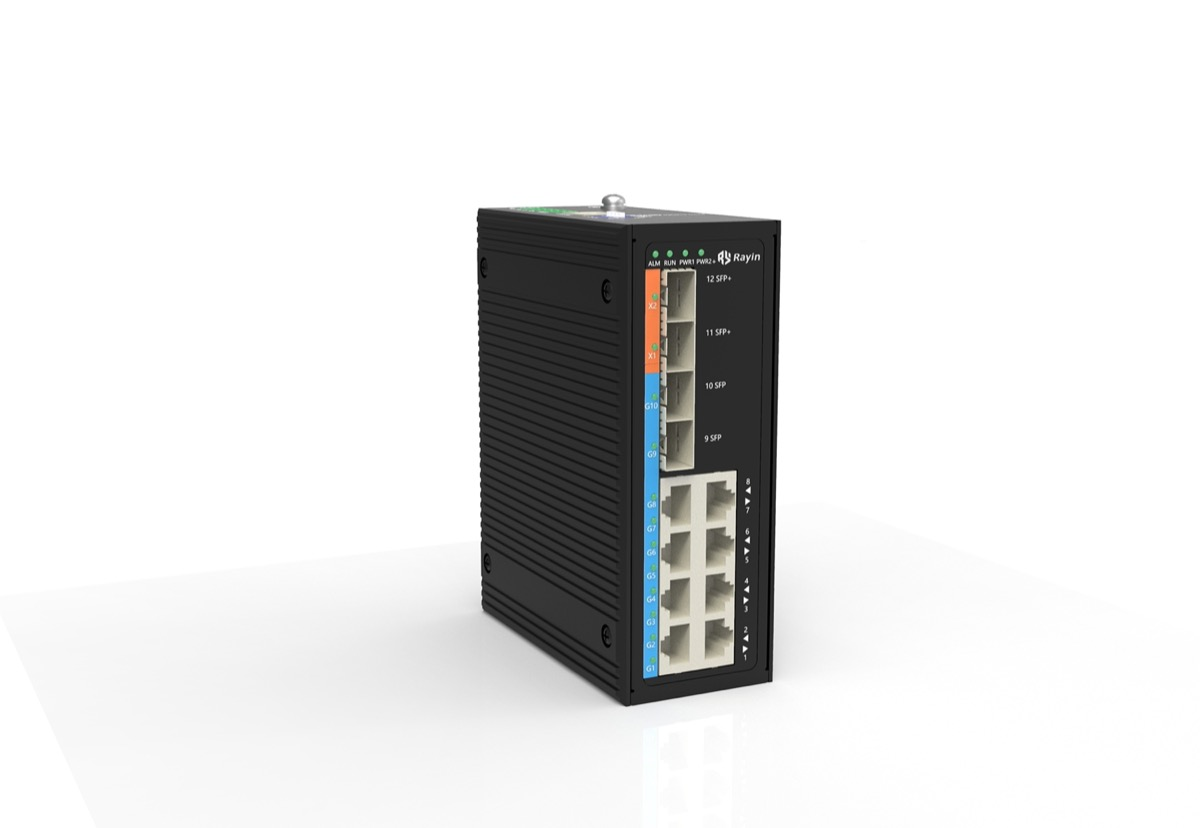
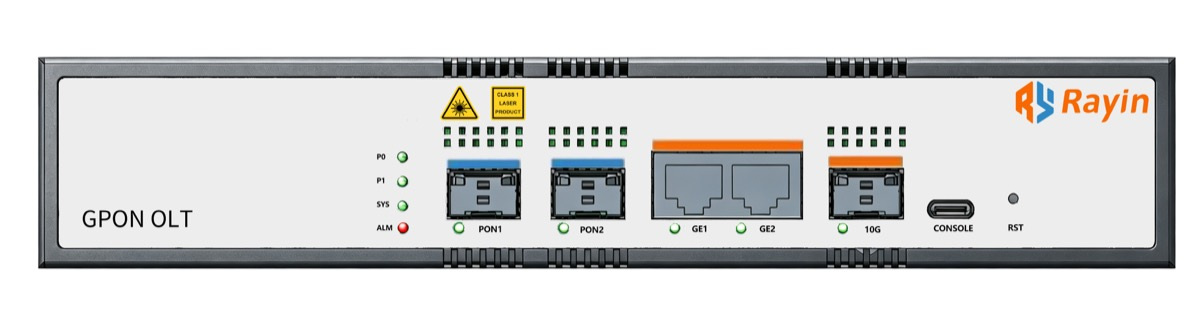
Because splitters are unpowered glass, a floor wiring closet holds a small passive distribution box, not a switch with a power feed and a fan. One riser fiber comes up from the OLT, a 1:32 or 1:64 splitter fans it out, and short drops run to each room's ONU. That removes an active device per floor together with the cooling and UPS that would follow it. Port density is the trade-off: a 200-room property cannot fit on one PON port, because the GPON registration ceiling is 128 ONU per PON port (ITU-T G.984 series). Plan two PON ports minimum, three if you want headroom, and label every splitter port against its room number in the handover diagram. In a hospitality network the riser count stays low, often one or two fibers for the whole building, while the ONU count scales with rooms. The OLT sits in the main equipment room with the uplink to the core; Rayin supplies mini GPON OLTs and industrial Ethernet switches for that wired head-end, and the larger-port GPON and XGSPON OLTs remain in development.
A switched design runs fiber to a floor switch and copper to each room; a PON design runs one fiber to a passive splitter and one ONU per room. Copper tops out at 100 m per run (industry-typical) while the ITU-T G.984 series allows up to 20 km of reach from the equipment room, so the comparison is not about speed, both deliver gigabit to the room, but about where powered devices live and how the plant grows.
| Dimension | PON (one fiber) | All-Ethernet |
|---|---|---|
| Powered device per floor | None, passive splitter | Access switch plus UPS |
| Riser fiber count | 1-2 for the building | 2 per floor switch, plus uplinks |
| Reach from equipment room | Up to 20 km (industry-typical) | 100 m per copper run |
| Service isolation | VLAN, GEM port, DBA | VLAN plus QoS on switches |
| Ceiling per head-end port | 128 ONU (ITU-T G.984 series) | Switch port count |
| Failure domain | One splitter tree | One floor switch |
Choose PON when the riser is long and you want no active gear in the closets; choose switched Ethernet when a floor already has power, cooling and a cabinet full of copper. The passive middle is the whole point of a one-fiber build, and a multi service PON only pays off if the VLAN map is written down once and kept current.
Commissioning is mostly optical measurement and records. Measure the downstream level at the furthest ONU and compare it with the design budget; a 1:128 link landing within plus or minus 1 dB of the calculated 28 dB (industry-typical) is a good sign, while a 3 dB drop across one splitter port points at a dirty connector. Check that each service VLAN reaches only its own ports, that IGMP snooping prunes the multicast group, and that DBA gives voice its fixed share. Then pull a drop fiber on purpose: fibre-cut detection at the OLT should raise a loss-of-signal event within seconds (industry-typical), and the log should name the ONU, not just the PON port. Keep the measured levels, the splitter-port-to-room map and the VLAN table in the handover file. Whatever management interface you use, CLI, web or SNMP, the record has to exist before a guest reports a dark screen.
Can one fiber really serve a whole floor of rooms?
In a hotel PON, yes: within the 128 ONU ceiling of one GPON PON port (ITU-T G.984 series). One riser fiber feeds a passive splitter and each room gets an ONU on its own VLAN. The real limit is optical loss, not bandwidth: at 1:128 the splitter alone costs 24-25 dB (industry-typical).
Do IPTV and guest internet need separate fibers?
No. They ride the same strand as separate logical services: each gets a VLAN, a GEM port and a DBA profile. Video uses multicast with IGMP snooping so one stream is copied at the splitter, not once per room. IEEE 802.1Q tags keep guest traffic out of the video VLAN.
Why does a 1:128 split need Class C+ optics on the OLT side?
Each doubling of the split adds about 3 dB of loss (industry-typical), so 1:128 reaches 24-25 dB for the splitter alone. Add fiber, splices and connectors and the total nears 28 dB. Class C+ (32 dB) OLT-side modules cover that budget; ONU-side optics remain Class B+.
How many PON ports does a 200-room property need?
At least two, because a GPON PON port registers a maximum of 128 ONU (ITU-T G.984 series). Two ports leave 256 registrations of headroom; three adds a spare. On a Rayin mini GPON OLT, split per floor so one cut never darkens the whole building.
What belongs in the handover file?
The measured optical level at the furthest ONU, the splitter-port-to-room map, the VLAN and GEM port table, and the DBA profile per service. Add the loss-of-signal event log from a pulled drop fiber. Label everything; the next engineer will not have your memory of which closet holds which splitter.
The wavelength plan, line rates, framing cycle and optical classes above come from public industry sources, the ITU-T G.984 series for GPON and IEEE 802.1Q for VLAN tagging. Only series names are cited; no clause numbers are quoted. Split-ratio losses and the worked budget are labelled industry-typical. The layout, comparison tables and wording were written by Sara, who checked each figure before publication. Nothing here is a measured Rayin product specification or a claim of any certification.
About the author: Sara — Sara is a Customer Manager at Rayin with over 10 years of experience in the communications field. In her free time, she enjoys badminton and swimming.
About Rayin: Shenzhen Rayin Technology Co., Ltd. — Company Profile