VLAN stands for Virtual Local Area Network, and one VLAN is one broadcast domain. If you came for the VLAN full form, that four-word expansion is the entire answer; the rest of this page is about what the grouping does inside a switch. A VLAN is a Layer 2 construct: ports that are nowhere near each other behave as one LAN segment, and broadcast frames stay inside that group. Read the abbreviation once, then treat the rest as engineering rather than vocabulary.
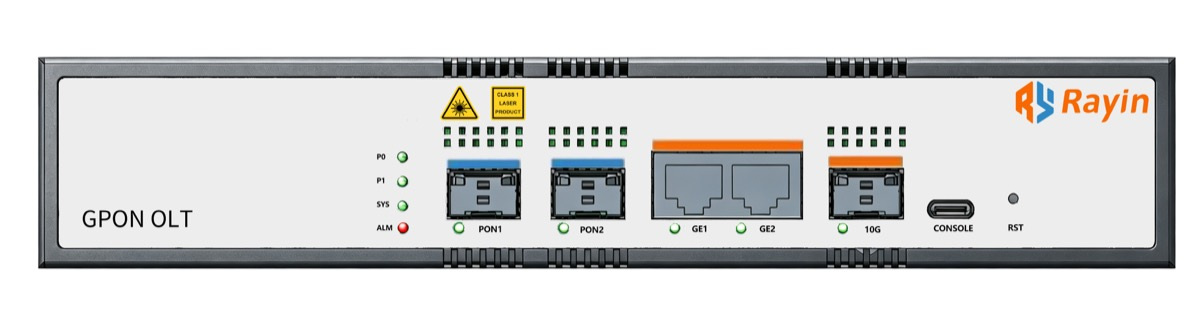
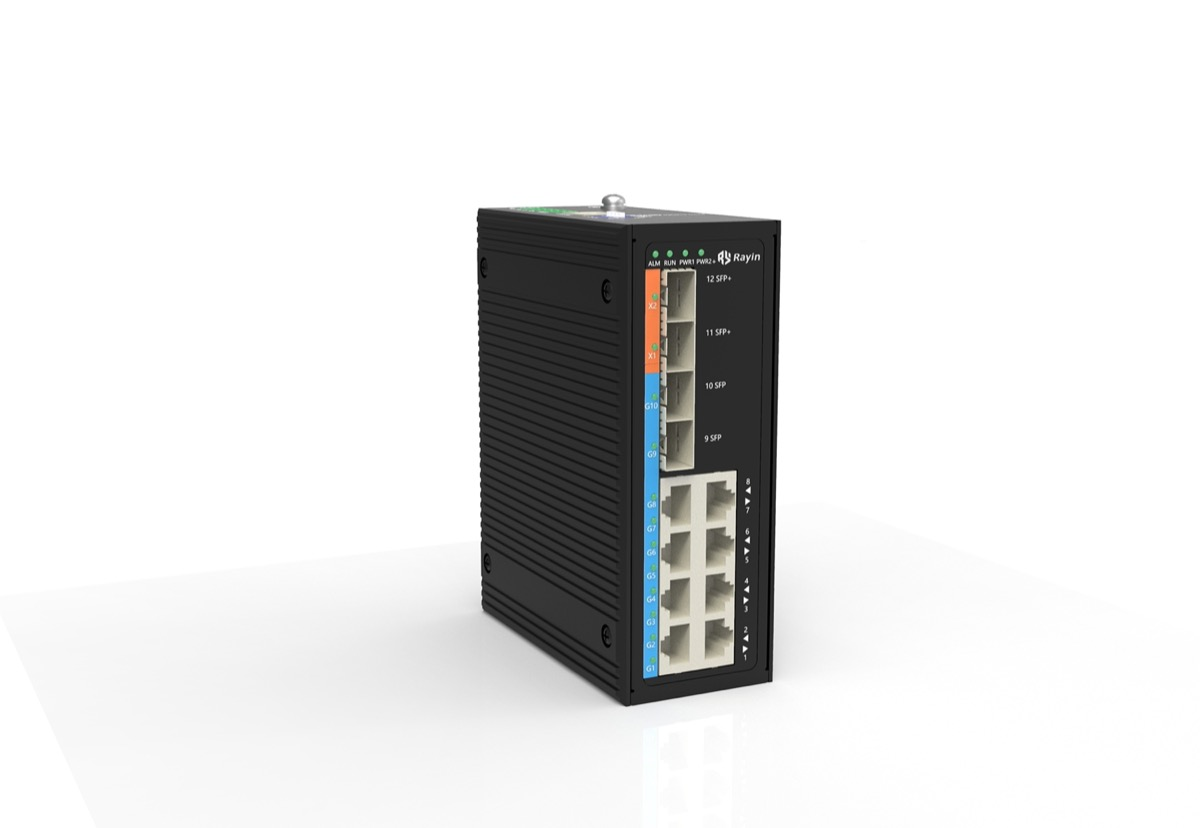
Rayin (Shenzhen Rayin Technology) is a manufacturer of GPON OLTs and industrial Ethernet switches.
VLAN expands to Virtual Local Area Network; operationally one VLAN is exactly one Layer 2 segment, not an IP subnet and not a second set of cables.
IEEE 802.1Q inserts a four-byte tag whose VID field is 12 bits, leaving 4094 usable VLAN IDs because 0 and 4095 are reserved.
An untagged port serves one VLAN, a trunk carries many tagged VLANs, and the line between them is where broadcasts stop.
Virtual means the grouping is logical, not a second bundle of copper. Local means the devices still share one LAN segment and its broadcast behaviour. Area means a set of ports, on one switch or across a stack. Network means the result forwards like an independent LAN at Layer 2. Put the four words together and you get a LAN that exists in configuration rather than in hardware. That is why a VLAN is a self-contained Layer 2 group: an all-ones MAC frame reaches every port in the group and no port outside it. Moving traffic between two such groups takes a router or a Layer 3 switch, because the split is a Layer 2 boundary. On a managed Rayin industrial Ethernet switch the same IEEE 802.1Q rules apply as on any standards-based device; the brand changes the hardware, not the frame format. The IEEE 802.3 series fixes the untagged maximum frame at 1518 bytes, a number worth keeping in mind before we add the tag.
The IEEE 802.1Q series inserts a four-byte header between the source MAC address and the original EtherType. Four fields sit inside it, and together they are the whole mechanism that turns a plain frame into a tagged one.
| Field | Bits | Value | Job |
|---|---|---|---|
| TPID | 16 | 0x8100 | Marks the frame as tagged |
| PCP (PRI) | 3 | 0 to 7 | Eight priority levels for QoS |
| DEI (CFI) | 1 | 0 or 1 | Drop eligibility / format flag |
| VID | 12 | 1 to 4094 | Identifies the VLAN |
TPID 0x8100 tells the receiver to parse the rest as a tag. The 3-bit PCP gives eight priority levels, the 1-bit DEI flags drop eligibility, and the 12-bit VID is the number people mean by "VLAN ID": 4096 possible values, with 0 and 4095 reserved, so 4094 are usable. Adding four bytes lifts the maximum tagged frame from 1518 to 1522 bytes under IEEE 802.3. For a byte-by-byte walkthrough, see the four fields in an 802.1Q tag and what each one carries. None of this is a Rayin-specific format; it is the shared standard that lets a switch from one vendor talk to an OLT from another.
A broadcast domain is the set of ports that receive the same broadcast frame. One VLAN draws exactly one such boundary, so ARP requests, discovery chatter and unknown-destination floods stay put instead of leaking into every other service. That is the practical answer to what a VLAN does: it trades one noisy LAN for several quiet ones.
| Physical LAN | One VLAN | |
|---|---|---|
| Boundary | Cables and ports | VID in the tag |
| Broadcast reach | One per LAN | One per VLAN |
| Change needed | Re-patch cables | Edit configuration |
| Scale | Port count | Up to 4094 IDs (IEEE 802.1Q) |
Under ITU-T G.984 a GPON PON port registers up to 128 ONU, and each service on that PON can be mapped to its own VLAN, which is why the same idea matters on an OLT as much as on an Ethernet switch. A router, not a switch, is what joins two of these domains.
An access port is assigned a single VLAN and sends untagged frames to the end device; the switch adds the tag internally and strips it on egress, so the PC, camera or ONU never sees a VLAN header. A trunk does the opposite: it carries tagged frames for many VLANs over one link and keeps them apart by VID. The two modes are where the boundary becomes physical, because that port is the edge of one group while a trunk is a shared highway for several.
| Property | Access ports | Trunk ports |
|---|---|---|
| VLANs carried | One | Many, up to 4094 |
| Frames on the wire | Untagged | Tagged (802.1Q) |
| Typical neighbour | PC, camera, ONU | Switch, OLT uplink |
| Broadcast group | One edge per port | Several carried together |
A 24-port switch can hold 24 separate access ports in different VLANs (industry-typical), then aggregate them onto one trunk. Get the mode wrong and you either leak one VLAN into another or drop tagged frames at an untagged port.
Above the access layer, tagged frames from many VLANs ride one uplink toward the OLT, and the VID is still what separates them. On a GPON OLT those service VLANs aggregate onto the uplink; when choosing an OLT uplink port that matches that tagged mix, the decision is about capacity and optics, not about the VLAN format, because the four-byte tag is unchanged end to end. ITU-T G.984 allows up to 128 ONU on a PON port, so one uplink can gather many tagged service flows. For an abbreviation question the point is that Virtual Local Area Network means the same thing at the access layer and at the OLT uplink; only the port mode changes.
Search results bundle the abbreviation question with multiple-choice items asking which fields are valid in a tag. Here is the direct answer in the same true-or-false wording used by those tests. The four valid fields are TPID, PCP, DEI and VID. The VID is 12 bits, not 16. The tag is four bytes, not eight. A VLAN needs no router to exist, only to reach a different VLAN. Each of those statements follows from the IEEE 802.1Q series, so a candidate who has memorised the four-byte layout can settle the whole set without recalling any product manual.
What does VLAN stand for, in full?
VLAN stands for Virtual Local Area Network. It is a logical Layer 2 grouping, so devices in one VLAN share one broadcast group even on different switches. It is not an IP subnet, though the two are normally planned together, and it needs no router simply to exist.
Is a VLAN the same thing as a subnet?
No. A VLAN bounds Layer 2 broadcasts; a subnet is a Layer 3 range of IP addresses. The two are usually mapped one to one for clarity, but that is a design choice, not a rule. Routing, not switching, moves traffic between different VLANs.
How many VLANs can an 802.1Q trunk carry?
The 12-bit VID field allows 4096 values, and IEEE 802.1Q reserves 0 and 4095, leaving 4094 usable IDs. A trunk is limited by how many you configure, not by the tag format. That 4094 ceiling is a field width in the standard, not a product limit.
Does a device on an access link see the tag?
Normally no. A device-facing port belongs to one VLAN and sends untagged frames; the switch adds the four-byte tag internally and strips it on the way out. On a Rayin managed switch, as on any standards-based device, the tag stays an internal label the PC never sees.
Do I need a Layer 3 switch to use VLANs?
No. A Layer 2 switch creates VLANs and keeps their broadcast domains separate on its own; membership lives in the tag and the port configuration. You only need routing or a Layer 3 switch when traffic must cross from one VLAN into another.
The abbreviation is the easy part: Virtual Local Area Network. The engineering is the boundary an IEEE 802.1Q header draws, the access port that puts a device in one group, and the trunk that carries many groups over one link. Get those three straight and the exam questions about valid tag fields answer themselves.
The frame-format statements above come from public sources: the IEEE 802.1Q series (the four-byte tag, TPID, PCP, DEI and the 12-bit VID), the IEEE 802.3 series (untagged and tagged maximum frame sizes) and the ITU-T G.984 series (GPON, including the 128-ONU registration ceiling). Only series names are cited; no clause numbers are asserted. The worked examples, comparison tables and wording are written by Sara, who checked each figure against those sources before publication. Anything presented as an industry-typical value is labelled as such; nothing here is a measured figure from a Rayin product or a claim of any certification.
About the author: Sara — Sara is a Customer Manager at Rayin with over 10 years of experience in the communications field. In her free time, she enjoys badminton and swimming.
About Rayin: Shenzhen Rayin Technology Co., Ltd. — Company Profile