For most small ISPs the break-even sits below a few hundred subscribers: a mini OLT vs chassis OLT decision is really three ceilings in a fixed order, registered ONUs first, optical budget second, bandwidth last, and the first one usually settles it. Neither form wins everywhere. A compact 1- or 2-port box costs less to buy, power and cool when the subscriber list is short; a shelf earns its keep when port density, redundant feeds and one management domain start to matter more than the invoice for the first box.
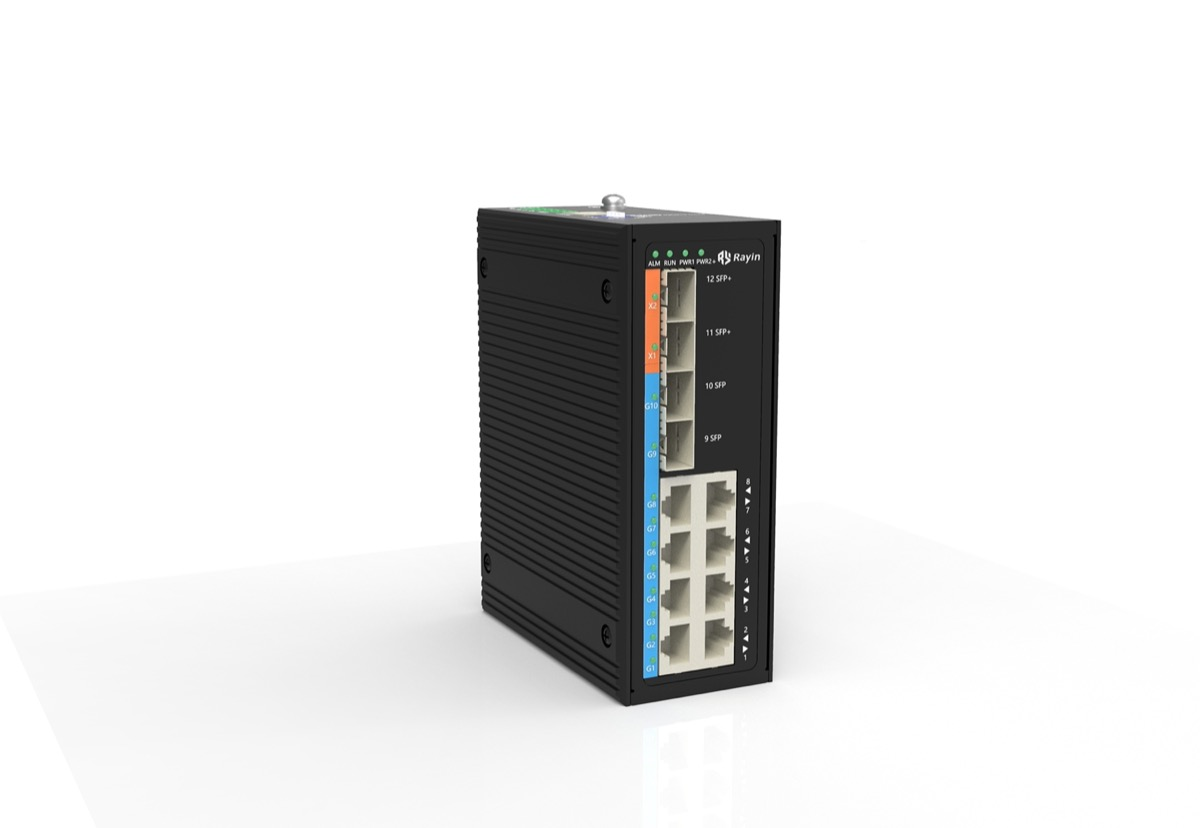
Rayin (Shenzhen Rayin Technology) is a manufacturer of GPON OLTs and industrial Ethernet switches.
Count registrations before anything else. ITU-T G.984 allows up to 128 ONUs per PON port, not 64, so two PON ports register 256 ONUs on paper before a single splitter or dB is considered.
The optical budget is the second ceiling. A 1:128 PLC splitter inserts about 24-25 dB (industry-typical), which against the 28 dB Class B+ limit of ITU-T G.984.2 leaves too little for fiber and connectors; a 32 dB Class C+ module on the OLT side is the usual answer.
Below an industry-typical 200-400 subscribers a standalone box is usually cheaper per port; past that, chassis density and common power supplies catch up. The cross-over is a calculation, not a brand preference.
Packaging, not the PON standard. Both run ITU-T G.984 GPON and both register up to 128 ONUs per PON port. A compact unit puts its 1-2 PON ports, uplinks and power supply in one fixed box; a shelf splits common equipment (power, fans, switching fabric, management) from pluggable line cards. That is why the shelf grows by adding cards and the box grows by adding boxes. Neither approach is a shortcut around the same 28 dB or 32 dB optical ceiling.

| Dimension | Compact standalone OLT (1-2 PON ports) | Chassis shelf (comparison class) |
|---|---|---|
| PON port density | 1-2 per box | 16-128 per shelf, industry-typical |
| Uplink | 1-2 fixed 1 or 10 Gbps ports | Multiple 10, 40 or 100 Gbps line cards, industry-typical |
| Power | Single AC or DC input, often fanless | Dual redundant -48 VDC feeds and fan trays |
| Redundancy | Box-level: add a second box | Card, power and uplink redundancy in one shelf |
| Management | One CLI or Web per unit, or a small cluster | One management domain for the whole shelf |
| Cost per port at low count | Lower upfront, industry-typical | Higher common-equipment cost, spread over more ports |
| Expansion path | Add another box and another uplink | Add a line card |
In this order: registrations, optical budget, bandwidth. ITU-T G.984 caps a PON port at 128 registered ONUs, so a 2-port unit tops out at 256 registrations, an industry-typical planning figure rather than a throughput claim. ITU-T G.984.2 then sets the optical budget at 28 dB for Class B+ and 32 dB for Class C+. Only after those two pass do you divide the 2.488 Gbps downstream and 1.244 Gbps upstream GPON line among active subscribers.
| Ceiling | Limit | Standard or source | What fails when you cross it |
|---|---|---|---|
| 1. Registered ONUs | 128 per PON port | ITU-T G.984 | New ONUs cannot register, even with clean optics |
| 2. Optical budget | 28 dB Class B+ / 32 dB Class C+ | ITU-T G.984.2 | Receive power falls below sensitivity and links flap |
| 3. Bandwidth | 2.488 Gbps down / 1.244 Gbps up per port | ITU-T G.984 | Contention rises; registration is unaffected |
This is the calculation most small ISPs skip. A 1:128 PLC splitter inserts about 24-25 dB (industry-typical). Add 3-5 dB for feeder fiber, connectors and splices (industry-typical) and the path sits near 27-30 dB. Class B+ at 28 dB under ITU-T G.984.2 has almost no margin left, so fit a Class C+ module with its 32 dB budget on the OLT side and leave the ONU side at Class B+. An optical power budget calculator or a plain worksheet forces you to add those terms in the same units instead of eyeballing the splitter figure.
| Term | Value (industry-typical) | Source |
|---|---|---|
| 1:128 PLC splitter loss | 24-25 dB | Splitter insertion loss |
| Feeder fiber and splices | 3-5 dB | Industry-typical link loss |
| Connectors and patching | 1-2 dB | Field measurement |
| Total path loss | 28-32 dB | Sum of the three lines above |
| Class B+ budget | 28 dB | ITU-T G.984.2 |
| Class C+ budget on the OLT side | 32 dB | ITU-T G.984.2 |
Work from subscribers, not from ports. Take an industry-typical 2-port box, a 1:64 split and 128 subscribers: each PON port carries 64 ONUs, comfortably under the 128 registration cap of ITU-T G.984, and the 1:64 splitter costs roughly 18-20 dB (industry-typical), so a 28 dB Class B+ budget still has margin. Double take-up to 256 subscribers and you either run 1:128 on both ports, with the Class C+ change above, or add a second box. That second box also means a second uplink, a second management address and a second power feed.
| Scenario | Subscribers (industry-typical) | Form that fits | Reason |
|---|---|---|---|
| Single rural cabinet | 60-120 | 1-port standalone box | 1:64 split, one PON port, 28 dB Class B+ is enough |
| Small town, first build | 200-400 | 2-port standalone box, or two boxes | Watch the uplink before adding PON ports |
| Multi-building campus or hotel | 100-300 | Compact box, 1:32 or 1:64 | Short ODN leaves spare dB |
| Several villages, one headend | 400-800 | Several boxes or a small shelf | Management hops and uplinks start to dominate |
| Town-wide central office | 800-2000 | Chassis shelf, comparison class | Density, dual power, one management domain |
| Regional point of presence | 5000 plus | Chassis shelf, comparison class | Line-card growth beats stacking boxes |
When the common-equipment cost is spread over enough ports, and when one management domain is worth more than a pile of small boxes. Neither form is inherently better: at 200 subscribers the shelf's dual -48 VDC feeds and fan tray are cost you do not need, while at 2000 subscribers forty standalone units are forty things to monitor, power and upgrade. ITU-T G.984 does not care which shape you buy. The 128 ONU registration limit and the 28 dB and 32 dB optical budgets in G.984.2 are identical on both.
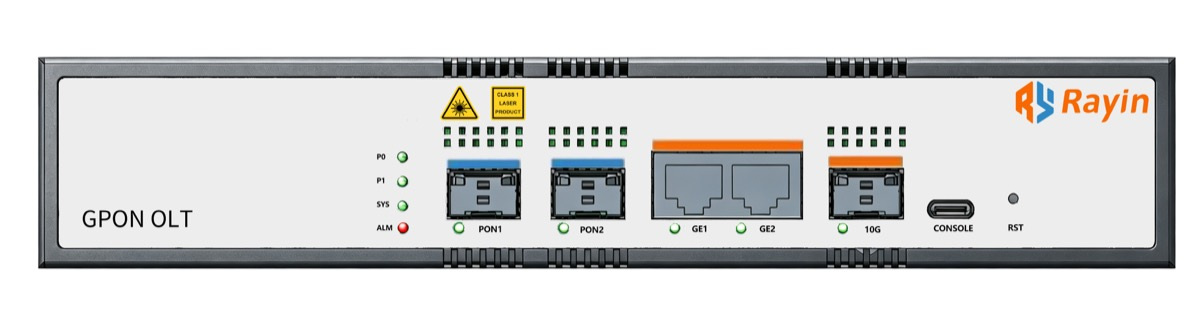
As one candidate in the left-hand column, nothing more. Rayin sells mini GPON OLTs in 1-port and 2-port versions, with the PON optical modules bundled with the OLT, and those are the boxes that fit the first three rows of the scenario table. Chassis OLTs are not in the Rayin line and appear here only as a comparison class. A 4-port and an 8-port unit are in development on the roadmap, not a shipping product, so plan the ports you can quote today and leave rack space for what comes later.

How many ONUs can one GPON PON port register?
A GPON PON port registers up to 128 ONUs under ITU-T G.984, not 64. The registration table is the first ceiling you hit, long before the optics or the bandwidth give out. Split ratio is a separate choice: 128 registered ONUs does not mean 128 active subscribers at full rate.
Does a 1:128 splitter force an ONU replacement?
No. The ONU side stays at Class B+; the change is on the OLT side, where a Class C+ module with a 32 dB budget under ITU-T G.984.2 absorbs the 24-25 dB loss of a 1:128 splitter plus fiber and connector margins. Replacing hundreds of ONUs is not the plan.
When should a small ISP stop adding standalone boxes?
Add a second box when the subscriber count, not the box count, crosses what one unit can serve cleanly. For an industry-typical 2-port standalone OLT at 1:64, that is around 128 subscribers; past 200-400 subscribers the uplink, management hops and spare power inputs of many small boxes start to cost more than one shelf.
Does Rayin sell chassis OLTs or 4-port boxes?
Rayin sells mini GPON OLTs in 1-port and 2-port versions, plus the PON optical modules bundled with them. Chassis OLTs are not in the Rayin line and appear here only as a comparison class. Four-port and eight-port boxes are in development on the roadmap, not a shipping product.
Do I need an optical power budget calculator for a two-port build?
Yes, even for two ports. A worksheet forces you to add splitter loss, fiber attenuation, connector and splice loss, then compare the total against the 28 dB Class B+ or 32 dB Class C+ limit in ITU-T G.984.2. A 24-25 dB splitter leaves almost no margin.
Pick the form that fails last. Count registered ONUs first, 128 per PON port under ITU-T G.984; check the optical budget second, 28 dB Class B+ and 32 dB Class C+ under ITU-T G.984.2; argue about bandwidth only after both pass. Below an industry-typical 200-400 subscribers one or two compact GPON boxes usually cost less to buy, power and manage, and beyond that the density and redundancy of a shelf earn their keep. Rayin's 1-port and 2-port units are simply one candidate in the left column, so hold them to the same three ceilings you would apply to any other box.
The standards and limits above come from public industry sources - ITU-T G.984 (GPON, including the 128 ONU registration limit per PON port and the 2.488 Gbps downstream and 1.244 Gbps upstream line rates) and ITU-T G.984.2 (Class B+ at 28 dB and Class C+ at 32 dB optical budget). The 24-25 dB insertion loss of a 1:128 PLC splitter, the 18-20 dB figure for 1:64, the subscriber break-even counts and the per-port cost comparisons in the tables are all industry-typical values, not measurements from a Rayin product. The method, worked examples and wording are written by Sara, who checked each figure against those sources before publication. Chassis OLTs are a comparison class only, and the 4-port and 8-port units are described as roadmap items in development.
About the author: Sara — Sara is a Customer Manager at Rayin with over 10 years of experience in the communications field. In her free time, she enjoys badminton and swimming.
About Rayin: Shenzhen Rayin Technology Co., Ltd. — Company Profile