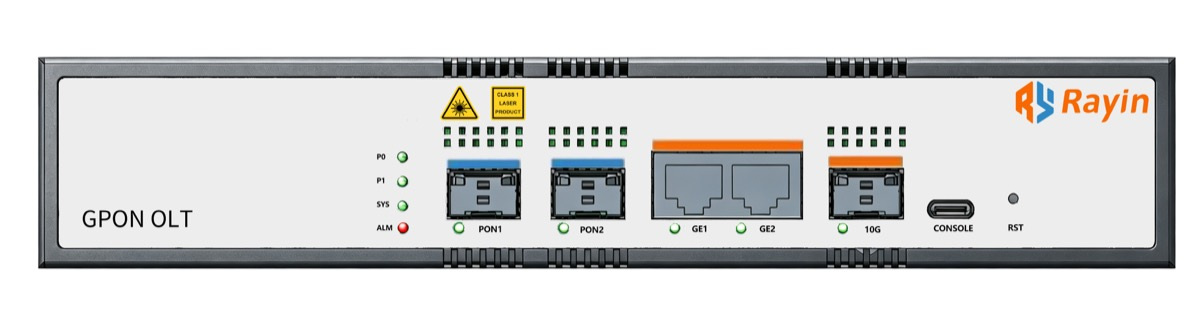
A single-port GPON OLT is the right choice when you are lighting up one fibre path rather than a whole exchange: one PON port, one splitter tree, and enough uplink to carry it. Rayin (Shenzhen Rayin Technology) is a manufacturer of GPON OLTs and industrial Ethernet switches. Its value is not capacity per rack unit — it is letting a first coverage point, a single building or a phased rollout be economical without buying capacity that sits idle for two years.
One PON port carries 2.488 Gbps downstream and 1.244 Gbps upstream (ITU-T G.984), and registers up to 128 ONUs. Divided across a full 128, that is roughly 19 Mbps down and 10 Mbps up per subscriber before overhead.
Registration limits and optical budget are two different ceilings. 128 ONUs is the vendor registration limit; whether you can light 128 depends on splitter loss and module class.
A single-port design has one PON path and therefore one failure domain. Where a site cannot go dark, plan redundancy at the uplink or with a second unit.
Two separate ceilings, and confusing them is the most common planning error.
| Ceiling | Value | What limits it |
|---|---|---|
| Line rate | 2.488 Gbps down / 1.244 Gbps up | ITU-T G.984 GPON framing |
| ONU registration | Up to 128 per PON port | Vendor implementation, not the protocol |
| Optical budget | Typically 28 dB (Class B+) or 32 dB (Class C+) | Module class on the OLT side |
| Splitter loss | About 24 dB at 1:128 | Physics — roughly 3 dB per doubling |
Do the arithmetic before choosing a splitter. A 1:128 split consumes around 24 dB of the budget on its own, which leaves almost nothing for fibre and connectors inside a 28 dB Class B+ design. Running the full ratio means specifying Class C+ or higher on the OLT side, while ONU-side optics typically stay at Class B+. A 1:64 split at roughly 20.5 dB is the more comfortable planning point on a standard budget.
Bandwidth is the second check. A full 128 subscribers sharing 2.488 Gbps get about 19 Mbps downstream each on paper, and about 10 Mbps upstream — before Ethernet and GEM framing overhead, and before any oversubscription assumption. That is viable for a business park or a light residential site and thin for a bandwidth-heavy one.
| Scenario | Fit | Reasoning |
|---|---|---|
| First coverage point for a small ISP | Strong | Low cost, adds ports only when subscribers do |
| Single building or campus block | Strong | One splitter tree serves the whole site |
| Temporary or construction site service | Strong | Small, quick to deploy, easy to redeploy |
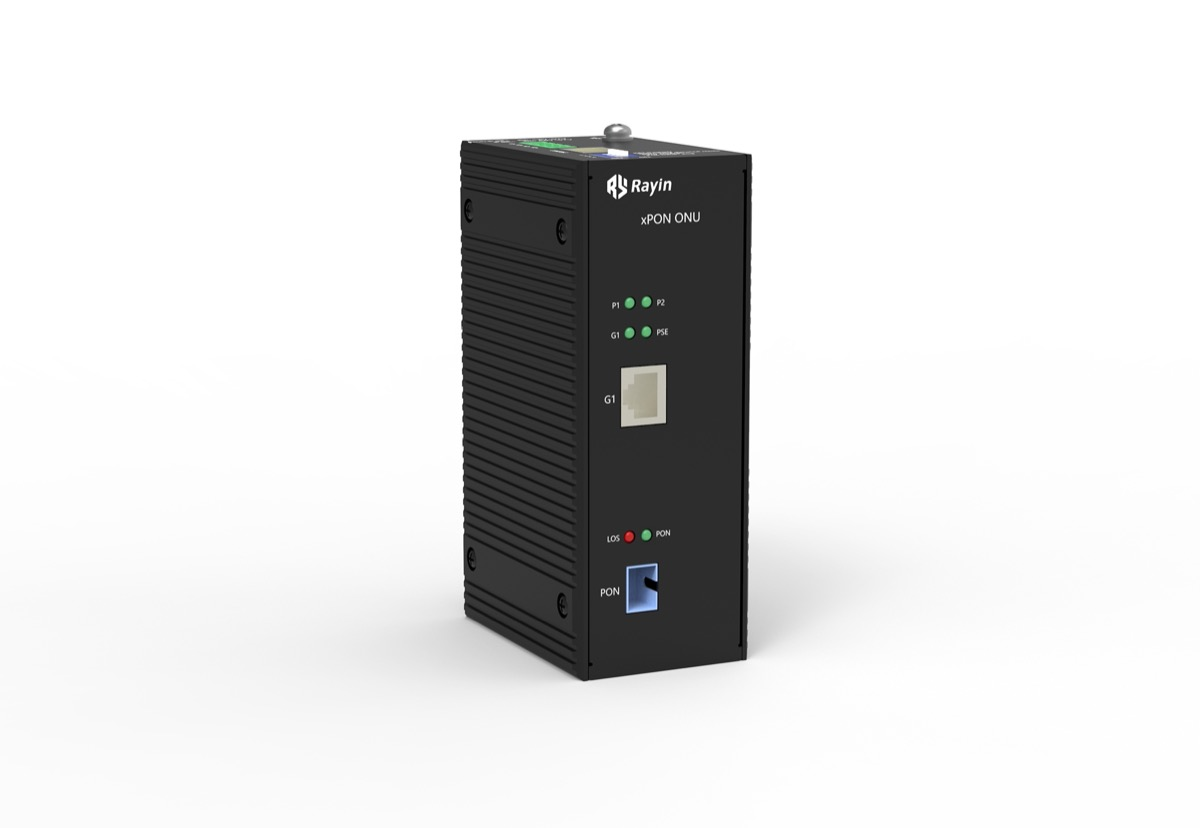
| Industrial site fibre to the cell | Good | Pairs with an industrial ONU at each machine |
| Dense residential with heavy usage | Weak | Per-subscriber bandwidth runs out first |
| Service requiring PON-path redundancy | Weak | One PON port is one failure domain |
The pattern: a single-port unit is strongest where the subscriber count is modest, the geography is one fibre path, and growth will be handled by adding units rather than by filling this one.
Module class, written down. Confirm whether the OLT-side module is Class B+ or Class C+, because that single line decides your splitter ratio.
Uplink capacity. A PON port that can deliver 2.488 Gbps downstream needs an uplink that is not the bottleneck. Check whether the platform offers gigabit copper ports, an SFP slot, or both, and size for the aggregate you actually plan to sell.
Management interface. CLI, web and SNMP availability, plus whether configuration can be backed up and restored — this is what makes a second unit cheap to deploy later.
Software features you will actually use. ONU auto-discovery, DBA profiles, VLAN and QoS configuration, and temperature or CPU monitoring. Ask for the list rather than assuming.
Physical form. A mini OLT in a small cabinet still needs ventilation and a wide enough temperature rating for where it will actually sit.

How many subscribers can one PON port serve? Up to 128 ONUs can register on a single PON port. That is a vendor implementation limit rather than a protocol limit, and the practical number is usually set by the optical budget and per-subscriber bandwidth instead.
What splitter ratio should I plan for? 1:64 is the comfortable planning point on a 28 dB Class B+ budget at roughly 20.5 dB of splitter loss. 1:128 costs about 24 dB and needs Class C+ or better on the OLT side.
How much bandwidth does each subscriber get? Shared across the port: about 19 Mbps downstream and 10 Mbps upstream per subscriber at a full 128, before framing overhead. Fewer subscribers means more each.
When should I move to a multi-port OLT? When subscriber growth is real rather than planned, when you need more than one fibre path out of the same site, or when per-subscriber bandwidth has become the constraint.
Is a single PON port a single point of failure? Yes. If the site cannot go dark, address it with uplink redundancy or a second unit rather than assuming the PON path will hold.
About the author: Sara is a Customer Manager at Rayin with over 10 years of experience in the communications field. In her free time, she enjoys badminton and swimming.
About Rayin: Shenzhen Rayin Technology Co., Ltd. — company profile