A ring industrial ethernet switch can shove traffic onto a backup link the moment a single fiber is cut or a connector works loose — and do it so fast nobody sees a stutter. That speed is not coming from a faster chip. It comes from a protocol built for rings: ERPS. ERPS is not the same logic as RSTP, which mainly exists to kill broadcast storms, or MRP, which PROFINET uses. Among industrial switches, this class is the pickiest about which redundancy protocol it actually runs.
Cameras at a factory, a tunnel, or an intersection are not just star-wired into one switch and done. To avoid losing a whole segment when one fiber breaks, crews chain the switches into a ring: A to B, B to C, and the last one back to A. Break any single span and data still loops back the other way.
The catch shows up immediately: a ring is a loop by nature, and a Layer 2 switch will forward broadcast frames forever, flood the MAC table, and take the whole network down. So a ring needs a mechanism that "blocks one path in normal operation, opens it on fault." That is exactly what a ring redundancy protocol does.
ERPS is ITU-T's G.8032 standard, written specifically for Ethernet rings. Its trick: in normal state, the RPL Owner — the switch that holds the Ring Protection Link — permanently blocks one designated link, the RPL. The loop is broken, so no broadcast storm can start.
When a working link fails, the neighboring switch fires an R-APS control frame right away, and the RPL Owner unblocks that RPL. The whole exchange stays between adjacent nodes; the ring does not re-elect a root or recompute topology the way spanning tree does. Because the action is deterministic and confined to the ring, ITU-T pins its switchover at under 50 milliseconds — and that is the worst case, not an average.
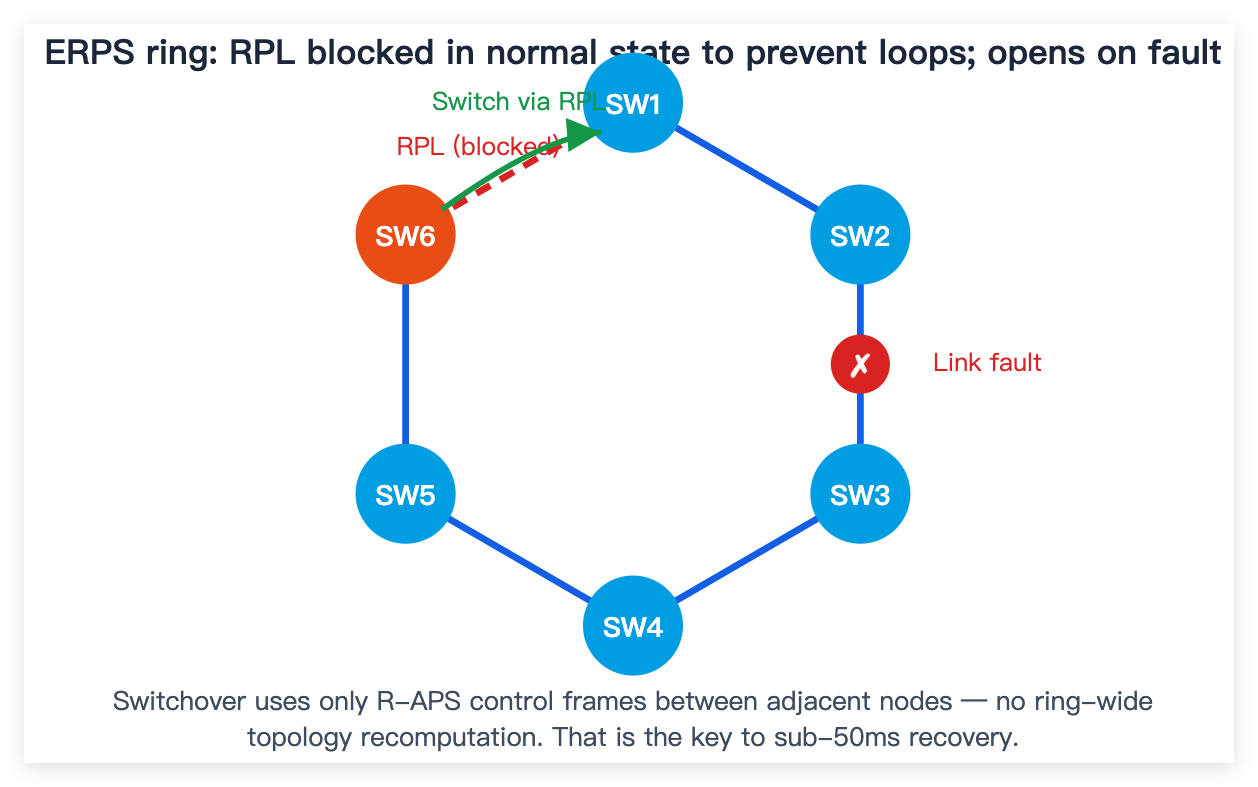
Figure 1 — On an ERPS ring, one RPL link stays blocked in normal operation to stop loops; on a break the RPL opens and traffic reroutes, with no whole-ring recompute.
RSTP (IEEE 802.1w) was built to stop loops in any mesh topology: it computes a loop-free tree and reconverges after a fault. Drop it on a ring and it still renegotiates hop by hop from the root bridge, with the entire network taking part. Typical convergence is 1–2 seconds; tune it hard and you might press it toward 100 milliseconds, but the jitter is large and there is no guaranteed upper bound.
For video surveillance, a brief drop-and-reconnect is tolerable. For intersection signal control or a production-line emergency stop, one or two seconds of network loss is enough to throw faults or halt the line. That is why RSTP usually sits only as a backup on industrial rings, never as the primary redundancy.
MRP (IEC 62439-2) is PROFINET's ring redundancy. One Media Redundancy Manager runs the whole ring and the other nodes just watch link status. It is deterministic too: recovery runs 10–200 ms depending on ring size, and a small ring can land under 10 ms.
Both MRP and ERPS are far quicker than RSTP, and they differ on two points. First, MRP basically supports a single ring with simple topology; ERPS in G.8032v2 supports multi-ring interconnection and cascading, which fits a large backbone. Second, interoperability: ERPS is a carrier-grade open standard, so implementations from Cisco, Moxa, and ThreeCo all speak G.8032 and can share one ring across brands. MRP leans toward the automation vendors' own camps. A Cisco switch and a Moxa switch in the same ERPS ring will interoperate; the same cross-brand mixing is harder with MRP.
RSTP recomputes its tree hop by hop across the whole ring and lands in seconds; MRP and ERPS were built for rings and converge deterministically.
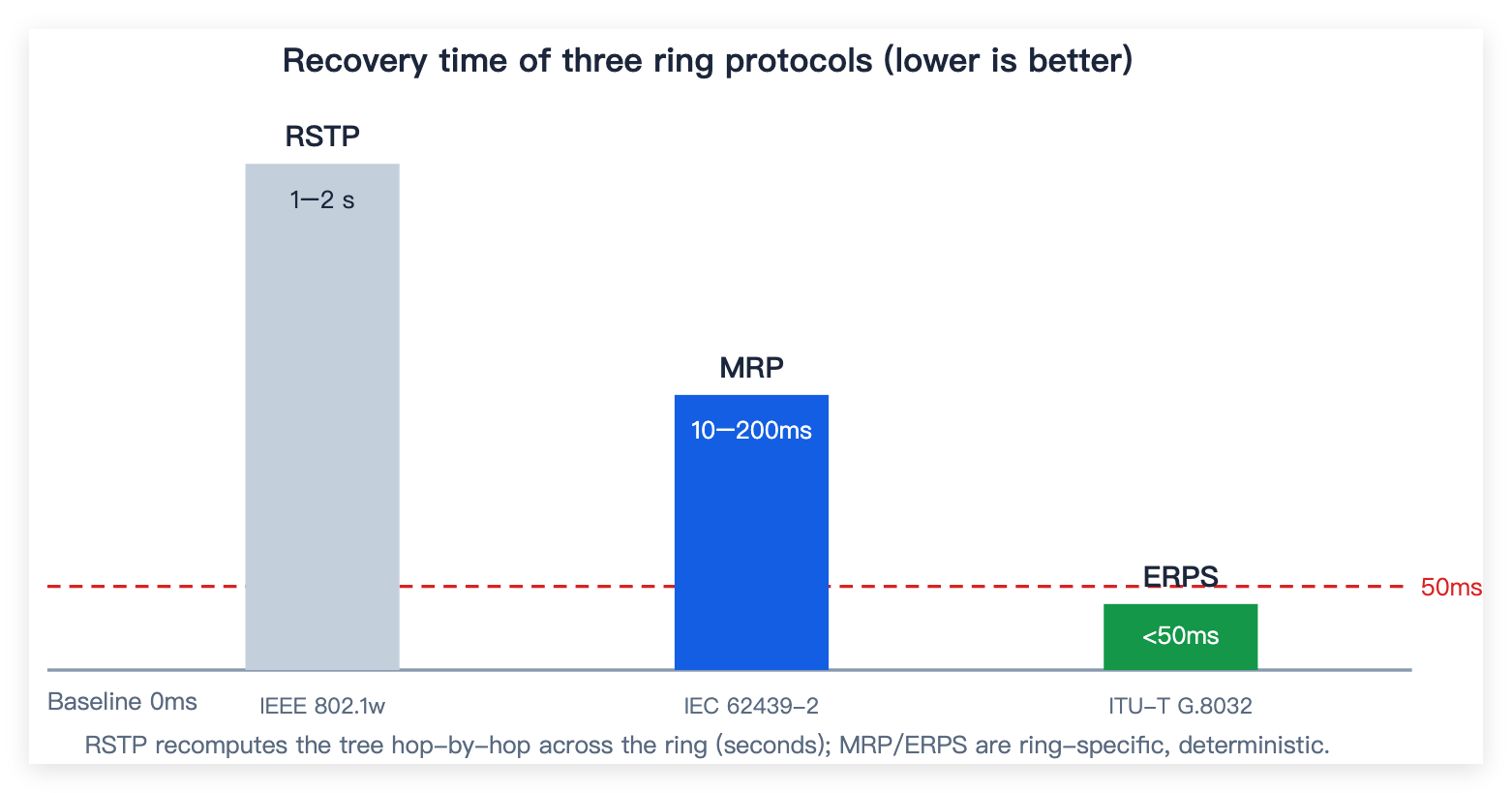
Figure 2 — RSTP is seconds-scale, MRP reaches into the low hundreds of milliseconds, and ERPS stays under the 50 ms line; the shorter the recovery, the better it suits a control loop.
Dimension | RSTP | MRP | ERPS |
Standard | IEEE 802.1w | IEC 62439-2 | ITU-T G.8032 |
Typical switchover | 1–2 s | 10–200 ms | <50 ms |
Convergence | Whole-network tree recompute | Single manager controls ring | Adjacent-node R-APS notification |
Topology | Any mesh / ring | Single ring (mostly) | Single / multi-ring interconnect (v2) |
Interop | Cross-vendor, good | Leans to automation camps | Carrier-grade open |
Representative vendor impl | Various managed switches | Siemens, Omron, etc. | Moxa Turbo Ring |
The 50 ms is a protocol switchover time, not a service recovery time. The tens of milliseconds it takes the MAC table and ARP table to relearn, and cameras to re-register, are not in that number — real perception usually adds a bit more. If you need genuinely zero-feel interruption, look at PRP/HSR (IEC 62439-3), which runs dual networks in parallel with zero switching.
Another trap is mixing vendors. If an MRP ring and an ERPS ring meet on the same Layer 2 without VLAN isolation, their loop detection fights: links flip open and closed by mistake and you get a loop anyway. Put a Layer 3 managed switch at the junction and separate them by routing, not by Layer 2 bridging.
Some also think a bigger ring saves cable. More nodes means one RPL carries more lateral traffic, and cross-half-ring latency gets obvious. A 12-camera ring and a 50-node ring are planned differently — the latter often splits into multiple rings plus aggregation. That planning gap is exactly where industrial and commercial switch firmware diverge.
1、Does a ring switch have to support ERPS?
Not necessarily. A small project can use a vendor's private ring — Moxa Turbo Ring— and still hit sub-20 ms switchover, as long as the whole ring is one brand. For cross-vendor mixing or a multi-ring backbone, ERPS (G.8032) is the safe choice.
2、How is an industrial ethernet switch different from a home switch on a ring?
A home switch has essentially no ring redundancy; wire it into a ring and you get a broadcast storm. An industrial ethernet switch is built wide-temperature, fanless, and DIN-rail mountable — but the real point is the firmware running ERPS, RSTP, and MRP so the link self-heals on a break.
3、Can RSTP and ERPS run together?
Yes, but not on the same layer. The common pattern is ERPS handling in-ring switchover while RSTP only backs up cross-ring or uplink paths, with the two kept apart by VLAN or Layer 3 — otherwise the protocols interfere.
4、Is ERPS 50 ms an average or a worst case?
ITU-T defines it as the worst-case ceiling. Under 50 ms means the switchover stays below that even at the most nodes and the longest links, not a benchmark average.
A ring industrial ethernet switch presses switchover under 50 ms through ERPS's deterministic logic of "block one RPL, open it on fault" — not through faster hardware. Pick the protocol by the interruption you can tolerate: seconds are fine, stay on RSTP; a control loop needs stability, go ERPS or MRP.
This article is compiled by Rayin, a specialist in industrial communication equipment. For more on ring redundancy and industrial ethernet switch selection, visit www.szrayin.com.