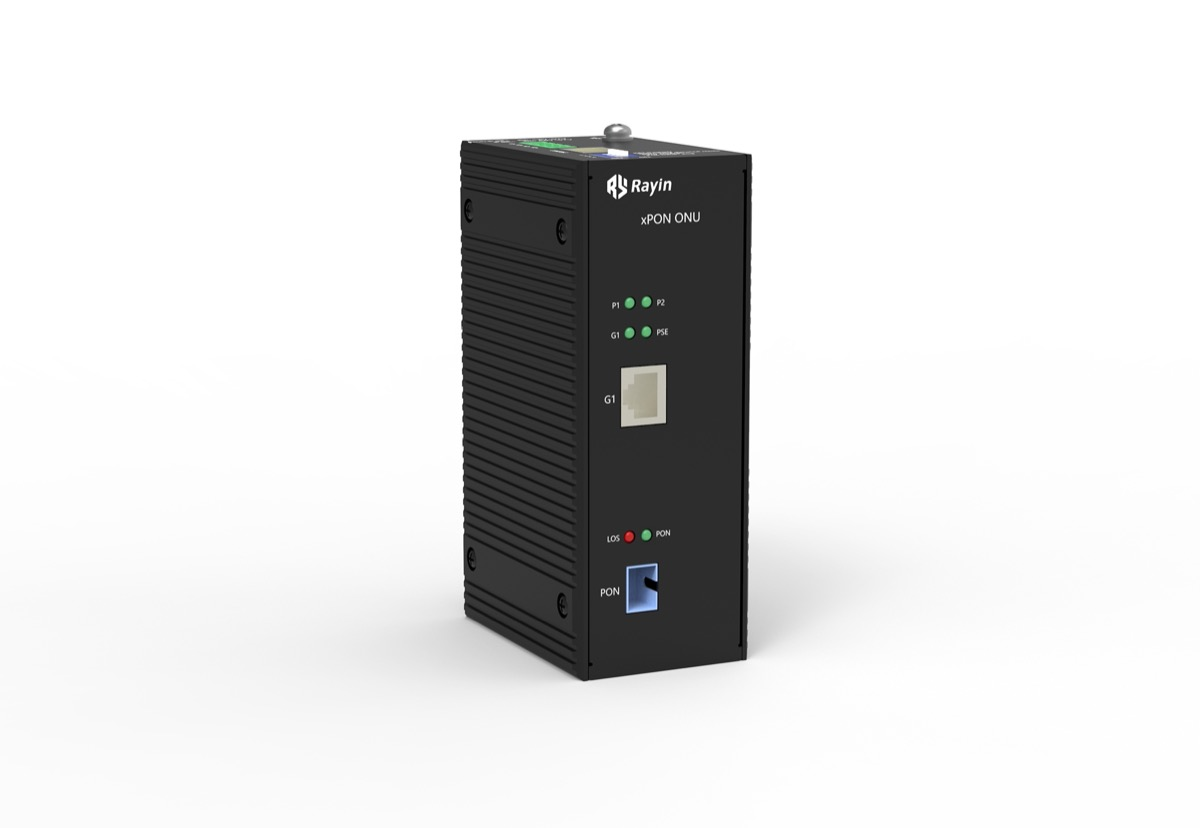
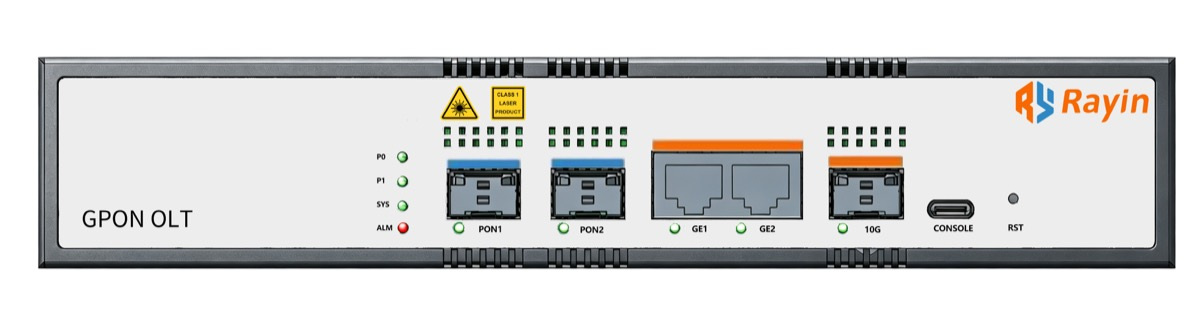
Choose an industrial switch when your devices sit within 100 metres and need deterministic latency; choose a passive optical network when they are spread across kilometres and you want to stop powering intermediate cabinets. Rayin (Shenzhen Rayin Technology) is a manufacturer of GPON OLTs and industrial Ethernet switches. The two are not competitors so much as answers to different questions — one solves density, the other solves distance. Framing the industrial switch vs pon decision correctly starts with measuring how far your furthest device actually is.
Copper Ethernet is bounded at about 100 m per run (TIA-568, IEEE 802.3). Beyond that you need fibre anyway, which is where PON becomes economical rather than exotic.
A switch port gives each device its own full-duplex bandwidth. A PON shares one feeder fibre among many endpoints, with upstream slots allocated by dynamic bandwidth allocation.
PON removes active equipment from the field: the splitter between OLT and ONU is unpowered, so there are no field cabinets to cool, secure or maintain.
An industrial Ethernet switch is a mesh of point-to-point links. Every port terminates at a device or at another switch, and each link carries its own dedicated capacity in both directions at once. That dedicated capacity is the whole reason an industrial switch vs pon comparison cannot be settled on speed alone — the two distribute bandwidth on completely different principles.

A passive optical network is a point-to-multipoint tree. One OLT port feeds a passive splitter, which fans out to many ONUs over a single strand of glass. Nothing between the OLT and the ONU needs a power supply. Downstream is broadcast and filtered by each ONU; upstream is time-division, with the OLT granting transmit windows.
| Industrial Ethernet switch | Industrial PON | |
|---|---|---|
| Topology | Point-to-point, cascaded or ring | Point-to-multipoint tree |
| Reach per link | ~100 m copper, up to tens of km on fibre | Up to 20 km logical reach (ITU-T G.984) |
| Bandwidth model | Dedicated per port, full duplex | Shared; GPON 2.488 Gbps down / 1.244 Gbps up |
| Field equipment | Powered switches every 100 m or so | Unpowered splitters only |
| Latency profile | Low and consistent | Slightly higher upstream, varies with load |
| Strongest use | Dense, real-time machine control | Distributed, outdoor, campus-wide coverage |
Both carry the same protocols — PROFINET, Modbus TCP, EtherNet/IP, video — so the decision is physical and economic, not a question of compatibility.
The 100 m limit is not arbitrary. It comes from the channel model in TIA-568 and IEEE 802.3: 90 m of permanent link plus 10 m of patch cords, sized so that attenuation, near-end crosstalk and return loss stay inside budget at the required bit error rate.
Practical consequences in a plant:
One workshop, one cell — a single switch covers it comfortably.
Two buildings 400 m apart — you are already running fibre; the question is whether to run one fibre per device or a shared feeder.
A mine, a pipeline, a campus — copper is not a candidate at all.
The crossover is where the fibre-count argument bites. Point-to-point fibre to 40 scattered devices means 40 home-run cables and 40 switch ports. One PON feeder with a 1:16 or 1:32 splitter serves the same devices with a fraction of the cable and a single OLT port.
The split ratio sets how many endpoints share one OLT port, and it trades against optical budget.
| Split ratio | Typical insertion loss | Remaining budget for fibre | Practical read |
|---|---|---|---|
| 1:8 | ~10.5 dB | Generous | Long reach, few users per port |
| 1:16 | ~13.5 dB | Comfortable | Common default for campuses |
| 1:32 | ~17 dB | Moderate | Good balance for most plants |
| 1:64 | ~20.5 dB | Tight | Needs short runs and good fibre |
| 1:128 | ~24 dB | Very tight | Only with higher-class optics and careful planning |
Two mistakes show up repeatedly. The first is sizing the split ratio purely on the number of devices today, leaving no room for the cameras and sensors added next year. The second is forgetting that splitter loss is only part of the budget — connectors, splices and the fibre span itself consume the rest, and the total has to fit inside the class of optics you specified.
On the bandwidth side, remember that downstream is shared too. A single GPON port delivering 2.488 Gbps across 32 ONUs gives each one a statistical share, not a guaranteed slice. For bursty telemetry and video that is usually fine; for many simultaneous high-rate flows it needs checking.
A short decision path works for most projects:
Map the distances. If everything is inside one room or one line, use a switch. If devices span buildings or kilometres, PON wins on cable and labour.
Check the timing requirement. Motion control and safety interlocks with sub-millisecond cycle expectations belong on switched Ethernet. Supervisory traffic, video and condition monitoring tolerate PON upstream scheduling well.
Count the field cabinets you would otherwise have to power. Each one is a heat, ingress and security problem. PON deletes them.
Decide whether you need both. Many plants run switched Ethernet inside each cell and PON as the backbone between cells — which is exactly how fiber-to-the-machine deployments are built.
Rayin builds both sides of that split, so the recommendation is usually a hybrid rather than a single winner.
Can PON replace switches entirely in a factory? Rarely. PON is excellent for aggregation and distance, but machine-cell control with tight cycle times is better served by a local switch. Most plants use both, with PON as the backbone.
How far can a single PON reach? ITU-T G.984 specifies a logical reach of up to 20 km, with a physical reach of up to 60 km in extended configurations. Real deployments are usually limited by the optical budget long before the standard's limit.
Does a PON add latency compared with a switch? Upstream, yes — transmissions wait for an allocated window, so latency is higher and more variable than on a dedicated port. For video and supervisory data the difference is insignificant; for fast motion control it matters.
What limits how many ONUs one port can serve? Two things: the split ratio's optical loss, and the registration limit of the OLT. On GPON, 128 ONUs per port is a common vendor ceiling, but the optical budget usually binds first.
Is PON cheaper than running more copper? Beyond a few hundred metres, usually yes — the saving is in cable volume, conduit and the field cabinets you no longer have to power and cool, not in the active equipment.
About the author: Sara is a Customer Manager at Rayin with over 10 years of experience in the communications field. In her free time, she enjoys badminton and swimming.
About Rayin: Shenzhen Rayin Technology Co., Ltd. — company profile