Fiber to the Machine takes the passive optical network that already serves buildings and pushes it all the way down to the machine, cell or AGV charging point, replacing the chain of copper switches in between with a single passive splitter. Rayin (Shenzhen Rayin Technology) is a manufacturer of GPON OLTs and industrial Ethernet switches. The appeal is arithmetic: fewer active devices in the field means fewer power supplies, fewer fans, fewer configuration points and a much smaller failure domain per cell.
The architecture collapses three layers into two. One OLT port, one passive splitter, and one ONU per machine replaces a cascaded copper chain with an active switch at every hop.
Distance stops being a constraint. Single-mode fibre runs kilometres where copper is capped at 100 m per link (IEEE 802.3), so the topology follows the production layout instead of the cable rule.
Latency is bounded, not constant. Upstream is scheduled by the OLT's dynamic bandwidth allocation, so plan for low single-digit milliseconds (industry-typical) rather than assuming wire-speed contention behaviour.
A conventional cell network runs core switch → floor switch → cell switch → device. Every hop is an active device needing power, configuration, firmware, a spare, and a place to live in a cabinet that is often too hot and too dusty. Every hop is also a failure domain, and every copper run is limited to 100 m.
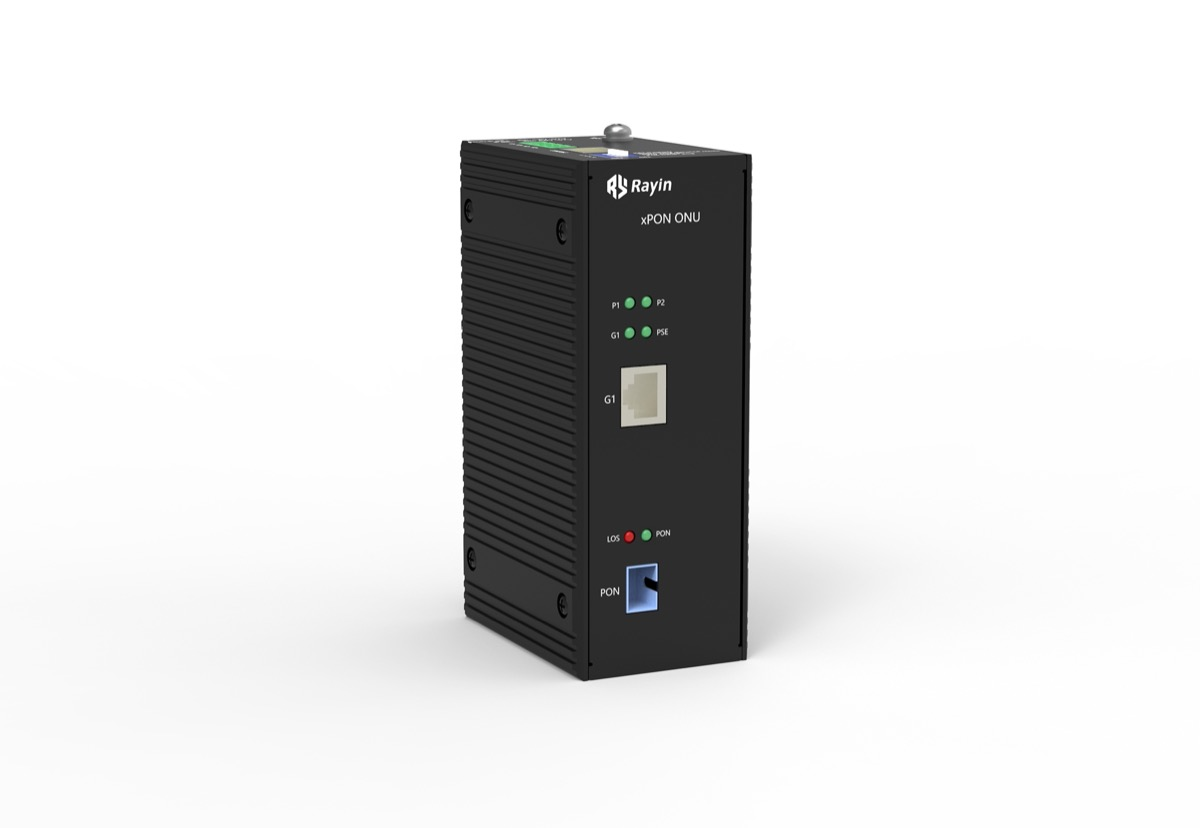
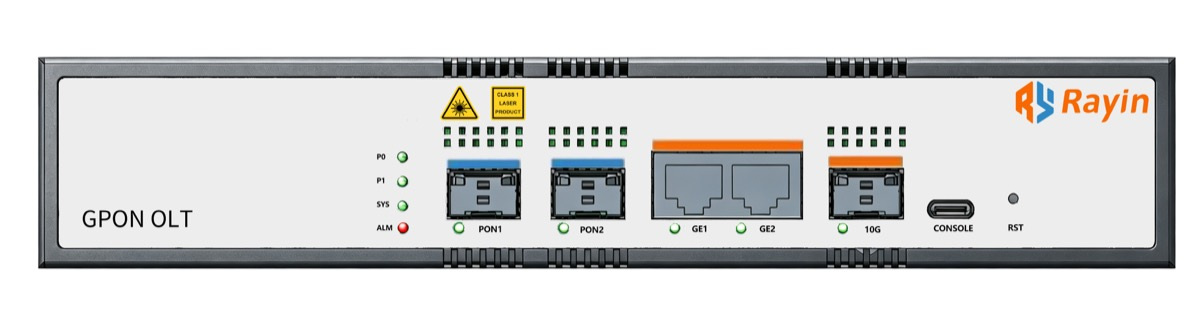
In a fiber to machine design the middle disappears. The OLT sits in the controlled environment. A passive splitter — no power, no fan, no management — fans the fibre out toward the production area. An ONU at the machine presents copper ports to the PLC, HMI or camera. Nothing between the OLT and the ONU can fail for want of software.
| Dimension | Cascaded industrial switches | Fiber to the Machine |
|---|---|---|
| Active devices in field | One per hop | One ONU per machine |
| Max distance per link | 100 m copper | Kilometres on single-mode fibre |
| Field power points | One per switch | One per ONU |
| Failure domain | Switch plus everything below it | One ONU |
| Reconfiguration | Physically recable | Change splitter port or ODN |
This is where fiber to machine projects succeed or fail, and it is a calculation you can do on paper before a single part arrives.
| Split ratio | Typical splitter insertion loss | Typical remaining margin on a 28 dB budget |
|---|---|---|
| 1:8 | ~10.5 dB | Comfortable |
| 1:16 | ~13.5 dB | Comfortable |
| 1:32 | ~17 dB | Workable |
| 1:64 | ~20.5 dB | Tight, design carefully |
| 1:128 | ~24 dB | Needs a larger budget class |
The figures above are industry-typical planning values: each doubling of the split ratio costs roughly 3 dB, plus excess loss in the splitter itself and connector and splice loss along the path. Add fibre attenuation at about 0.4 dB/km at 1310 nm and about 0.3 dB/km at 1490 nm (industry-typical), then confirm the total sits inside the budget class of the optics you intend to buy.
A commonly missed detail: a 1:128 split needs roughly 24–25 dB of splitter loss alone, which does not fit inside a 28 dB Class B+ budget with any real margin. Running the full ratio means moving the OLT-side module to Class C+ (32 dB) or higher while the ONU side can stay on Class B+. On the subscriber side, remember the registration ceiling: a single PON port registers up to 128 ONUs, and that limit is a vendor implementation limit rather than a protocol one.
Careful here. Downstream is broadcast and fast. Upstream is scheduled: the OLT grants transmission windows through dynamic bandwidth allocation, which removes collisions but introduces a grant delay that varies with load. Industry-typical PON latency is in the low single-digit milliseconds, and it is bounded rather than fixed.
That is fine for machine vision upload, AGV telemetry, HMI traffic and historians. It is a question mark for hard motion control, where a jitter budget in tens of microseconds is the usual target. In practice the split is:
Put on FTTM: video, telemetry, MES traffic, and any device whose controller is local to the cell.
Keep on industrial Ethernet: motion control, safety-related traffic, and anything already running on a TSN schedule.
Verify, do not assume: measure latency and jitter on the actual configuration before committing a production line to it.
Is FTTM the same as POL or F5G? They share the same passive optical foundation. FTTM is the specific case where the endpoint is a machine, cell or controller rather than a desk, an AP or a hotel room.
How far can a machine be from the OLT? Kilometres, subject to the optical budget rather than a cable rule. Single-mode fibre removes the 100 m copper limit that usually dictates where switches have to sit.
Can I run a 1:128 splitter everywhere? Only if the budget supports it — 1:128 costs about 24 dB of splitter loss alone, so you need Class C+ optics or better on the OLT side and margin for fibre and connectors.
Does the splitter need power or cooling? No. That is the point. The splitter is passive, so the field contains no active device between the OLT and each ONU.
What breaks first in an FTTM deployment? The ODN: dirty connectors, tight bend radius and bad splices. Budget for inspection and cleaning at commissioning rather than debugging it after handover.
About the author: Sara is a Customer Manager at Rayin with over 10 years of experience in the communications field. In her free time, she enjoys badminton and swimming.
About Rayin: Shenzhen Rayin Technology Co., Ltd. — company profile