What is the GPON + POF monitoring solution? It means full optical monitor, it is an full optical networking architecture that combines GPON with POF to provide high-bandwidth, long-distance, and secure data transmission for IP surveillance.
1. Currently, the IPC mainstream access is:
1.1POE Ethernet access, through Category 5 or Category 6 network cable while transmission network data + POE power supply, IPC directly access the POE switch, the switch is reconnected with the NVR or monitoring platform.
1.2 Point to point access by optical fiber transceivers, it is the standard solution for long distance outdoor monitoring over the past decade. It is still widely used today.
1.3 PON (Passive Optical Network) access network, full optical monitor, deploy an OLT in the computer room, It is connected to passive optical splitters via optical fibers. After the single-core fiber is split, it is used to connect multiple front end ONU devices. Each ONU is connected to 1 or multiple cameras.
1.4 The wireless solution, which is only a complement to wired access way, mainly for difficult wiring scenarios.
2. Rayin Technology's GPON + POF full optical monitor solution integrates the ONU directly into the camera.
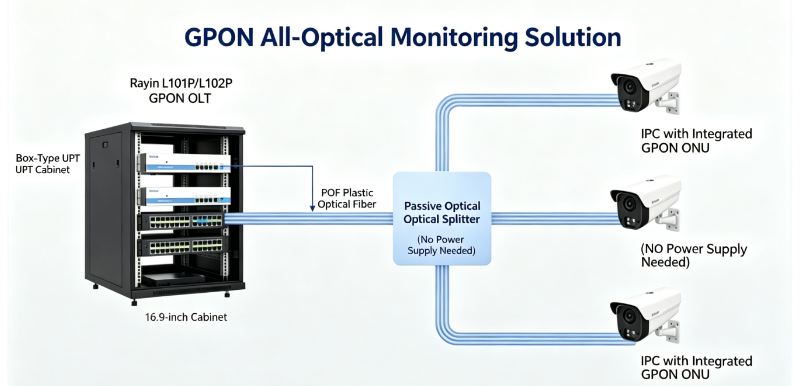
In our full optical monitor solution,We adopts the architecture of L101P/L102P box-type 1-port/2-port GPON OLT + IPC built-in single-port GPON ONU + POF plastic optical fiber. It give up the traditional fiber transceiver and switch solutions and realizes "one fiber to the camera", achieving a minimal transmission.
Scheme architecture diagram:
Core product:
1.1 Rayin’s L101P/L102P GPON OLT, a box-type small OLT specifically designed for small and medium-sized monitoring scenarios
L101P: 1 GPON port, 2 GE uplink electrical ports, 1 SFP+ 10G uplink optical port. Each port supports 128 cameras. Suitable for small parks, stores, and factories;
L102P: 2 GPON ports, 2 GE uplink electrical ports, 1 SFP+ 10G uplink optical port, capable of supporting up to 256 cameras, suitable for medium and large-sized campuses, schools, and residential areas;
support unified management, plug and play, zero configuration activation;
support port isolation, bandwidth limit speed, Vlan division, and ensure monitoring of video flow stability transmission.
1.2 The built-in single port GPON ONU
super small size design, directly integrated in the IPC camera, without extra space;
no nee external power supply need or additional network cables. Powered by POF;
conform to the ITU-T G.984 GPON standard, compatible with mainstream manufactures;
support AES-128 encryption and ensure video data security.
1.3 POF plastic optical fiber transmission medium, using communication-grade GI-POF gradient refractive index plastic optical fiber
support the Gigabit rate, the maximum transmission distance 500 meters, fully covering the monitoring point deployment;
non-metallic medium, non-conducting, anti-lightning, immune electromagnetic interference, zero risk in outdoor and industrial environment;
the bending radius is small and can be bent at will, and the construction of the pipe is much less difficult than the net and quartz fiber material.
3.FAQ
Q1: What is the maximum transmission distance of this solution, the full optical monitor?
A: By GPON technology, the transmission distance can extend up to 20 km without adding other switches or repeaters advice, successfully eliminating the 100 meters limit of copper cables.
Q2: How does GPON technology upgrade standard IP camera systems?
A: Traditional IP monitoring is limited by the 100 meter distance constraint of copper wires. By utilizing GPON, the transmission distance can easily extend up to 20 km. It provides massive bandwidth , up to 2.5 Gbps downstream, for a single fiber, successfully eliminating video lag and packet loss for IP cameras.
Q3: Do I need to replace my existing IP cameras to use the full optical monitor solution?
A: No. You can easily connect your existing IP cameras to the full optical network using standard ONUs or media converters.