According to statistics, on one hand, because of the worldwide development including 4K/8K high-definition monitoring, Wi-Fi 7 wireless, machine vision, cloud AI analysis, and the large-scale deployment of massive IoT terminals, the traffic of single devices, and the number of simultaneously online terminals have continued to grow. On the other hand, with data storage and operational platforms fully transitioning to the cloud and parallel transmission of multiple services, the demand for network bandwidth in all industries has been increasing year by year. These growing demands cause extra difficulties for customers when selecting PON related products and industrial network switching equipment for on-site networking. This article will analyze the technical specifications of the current mainstream OLT technologies: XGSPON, XGPON, and GPON.
1. Wavelength and Splitting Ratio | Core Parameters of Industrial PON Access Devices
a. GPON
Wavelength Range:
Downstream: 1480–1500nm, Center 1490nm
Upstream: 1290–1330nm, Center 1310nm
Splitting Ratio: 1:128;
b. XGPON (Asymmetric 10G PON, 10G Downstream / 2.5G Upstream)
Wavelength Range:
Downstream: 1575–1580nm, Center 1577nm
Uplink: 1260~1280nm, Center 1270nm
The spectrum has no overlap with GPON, splitting ratio 1:128.
c. XGSPON (Symmetrical 10G PON, 10G in both directions)
Wavelengths are completely consistent with XG-PON:
Downstream: 1575–1580nm, Center 1577nm
Uplink: 1260~1280nm, Center 1270nm
Can be mixed and networked with XGPON and GPON on three wavelengths, splitting ratio 1:256.
2. Standards and Technological Evolution| Iteration History of Fiber Access Networks
a. GPON:
Standard: ITU-T G.984 series, officially finalized in 2003, replacing earlier BPON.
b. XGPON:
Standard: ITU-T G.987 series, released in 2010, fully named XG-PON1.
c. XGSPON:
Standard: ITU-T G.9807.1, based on XGPON evolution, enhances symmetrical rate capabilities.
The first version was finalized in June 2016, and the current official version was updated in February 2023.
Overall, technological development follows the principles of wavelength compatibility, utilizing existing fiber optics, and smooth capacity expansion. GPON lays the foundation for basic broadband → XGPON addresses downstream bandwidth bottlenecks → XGSPON solves the bottleneck of upstream transmission.
3. Principle of XGPON and XGSPON Fiber Mixed Networking | Compatibility Solution for Legacy Optical Network Upgrade
a. Downstream direction:
OLT broadcasts a unified 1577nm optical signal downstream, simultaneously containing XGPON frames and XGSPON frames;
Two types of ONU recognize their respective dedicated frame formats:
XGPON ONU only parses the 2.5G upstream specification XG frames, discarding XGSPON symmetrical 10G frames;
XGSPON ONU only parses the symmetrical 10G full-speed XGS frames, filtering out XGPON asymmetrical frames;
There are no signal conflicts downstream, relying solely on terminal chip protocol recognition to distinguish data flows.
b. Upstream direction:
The upstream also uses a wavelength of 1270nm, but they will not interfere with each other. The core mechanism is TDMA (Time Division Multiple Access) time scheduling.
All ONUs are passively optical and can only transmit uplink optical signals when the OLT allocates a dedicated time slot; the optical transmitter is turned off at other times.
The OLT issues a bandwidth mapping table (BWmap), assigning non-overlapping independent time slots to XGPON ONUs and XGSPON ONUs.
Rate differentiation and isolation;
The uplink transmission rate of XGPON ONU is fixed at 2.5Gbps;
The uplink transmission rate of XGSPON ONU is fixed at 10Gbps;
As long as the OLT PON module (combo module) simultaneously supports dual-rate demodulation at 2.5G/10G, it can separate the uplink data of the two rates without interference.
4. Three-mode Combo PON module | Multi-standard compatible OLT optical component
To achieve coexistence of three modes on a single fiber, the OLT must be configured with a Combo PON module that supports all three rates;
The Tri-Mode Combo PON module is an integrated WDM Optical-Electrical Module compatible with GPON, XGPON, and XGSPON. Its core principle is to achieve interference-free transmission through optical WDM separation and electrical layer time-division protocol.
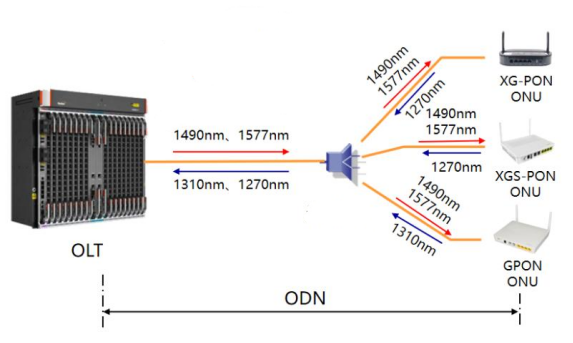
The module includes a built-in high-precision optical splitter that can distinguish two groups of independent wavelength bands:
GPON operates at 1490nm for downstream and 1310nm for upstream,
XG/XGSPON uses 1577nm for downstream and 1270nm for upstream. The physical isolation of GPON and 10G PON signals is achieved through wavelength differences, completely eliminating crosstalk.
XGPON and XGSPON require the OLT chip to work in coordination (the OLT chip must support triple-mode; some OLTs only support dual-mode, specifically GPON/XGPON and GPON/XGSPON). Through TDMA (Time Division Multiple Access) technology, it allocates non-overlapping upstream optical transmission slots for the two types of devices. Additionally, the module supports dual-rate demodulation at 2.5G/10G, accurately distinguishing between upstream data streams of XGPON 2.5G and XGSPON 10G.
5. Conclusion
Because the PON technology consider how to utilize the same fiber optic cable, there's no need to panic if your current products are all use GPON. You do not need to completely replace your existing fiber network; And by reasonable adoption of Combo OLT, you can achieve a smooth transition from GPON to XG/XGSPON, and your existing fiber investment is still usable.
Engineers at Rayin Technology have accumulated over ten years of experience in the R&D of PON products, analyzing Combo PON OLT and Combo PON module technology, providing efficient, flexible, and scalable upgrade solutions for small and medium-sized operators, enterprises, hotels, surveillance, and other application scenarios. With Rayin Technology's Combo OLT products, the network can not only meet current business demands but also be workable for the future evolution to 50G PON.
For more product details on industrial switching hardware for on-site networking and technical solutions, please visit our official website: www.szrayin.com. We will provide you with professional technical support and customized solutions.