With the large-scale implementation of Passive Optical Networks (PON) in enterprise campuses, hotel apartments, transportation hubs, and industrial sites, PoE Ethernet power supply has become a standard feature of the PON access layer, leading to the widely used of multi-port powered PSE ONU.
In a typical PON architecture, the optical signals issued by the Optical Line Terminal (OLT) terminate at the Optical Network Unit (ONU). The PSE ONU device, compatible with industrial terminals, performs two core functions: firstly, it completes the two-way conversion between optical signals and Ethernet electrical signals; secondly, it provides power supply to downstream terminal devices through the PoE module, covering all categories of IoT terminals such as Wi-Fi access points, HD security cameras, IP phones, and access controllers, perfectly matching the usage requirements.
PoE technology completely eliminates the need to deploy local power sources for each terminal, significantly reducing wiring workload and construction costs, while also lowering subsequent maintenance cost. This technology is especially suitable for enterprise offices, retail stores, and branch scenarios with broad floor distribution, numerous terminals, and scattered locations, and at the same time these are also the mainstream application environment for distributed deployment of PSE ONU.
This article will focus on a detailed discussion of the design of PSE ONU, analyzing the implementation principles of core functions of the device and structural design, and deeply interpreting the advantages of lightweight PSE ONU in small to medium-sized scenarios, completing a technical analysis and application summary of PSE ONU devices.
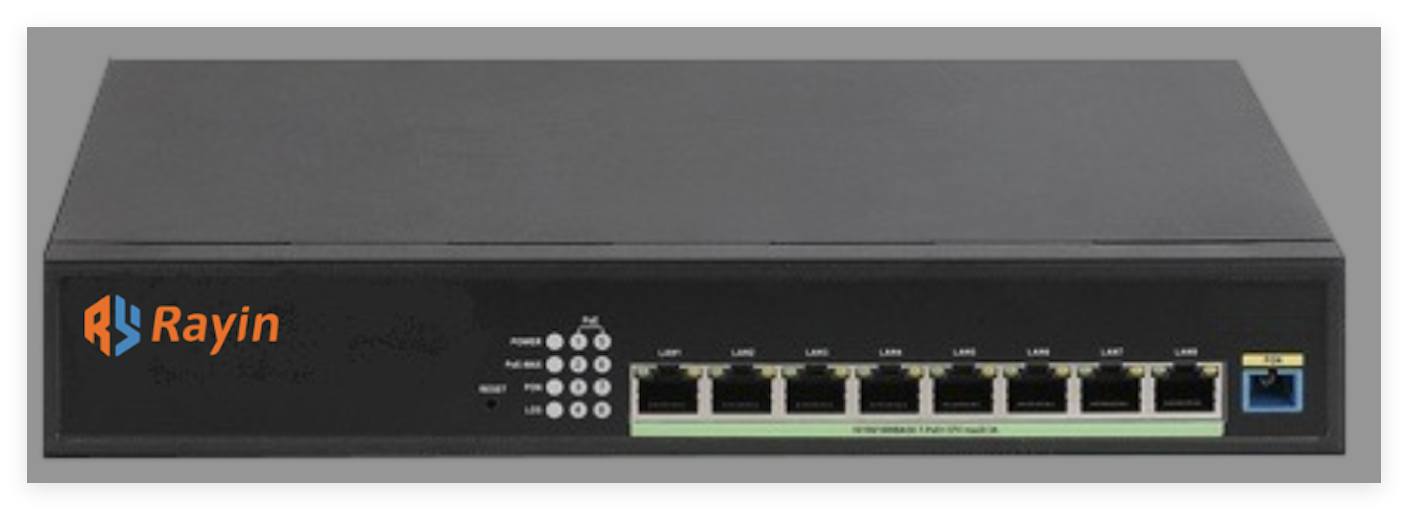
1. Built-in Power Supply & External Power Supply
Currently, there is a wide variety of ONU products capable of PoE power supply on the market. Different device manufacturers adopt distinct design solutions based on their own technical accumulation and product position, and till now in the market there isn’t a unified industry standard. Looking at the mainstream development paths of small to medium-sized networking PSE ONU manufactures, they can basically be divided into two categories, which are also the two core hardware design architectures for commercial scenario PSE ONU, the first is an integrated built-in power supply design, embedding the power supply module within the device for a more unified overall structure; the second is an external PoE power supply design, providing power support to the device and downstream terminals through external power accessories. In fact, both solutions have their advantages and disadvantages.
Currently, the key parameters of the two power supply designs are compared as follows:
| Comparison Items | Built-in Power Supply PSE ONU | External Power Supply PSE ONU |
| Power | Power supplies of different capacities can be designed based on the device's POE power budget. | Most external adapters have a maximum power of 120W, supporting up to 8 PoE+ ports (30W per port), suitable for ONU devices with up to 8 ports. |
| Heat Dissipation Design | The overall power consumption is high, requiring professional design for heat dissipation to ensure stable operation of the device. | The power supply is completely separated from the host, only the ONU's heat dissipation needs to be considered. |
| Reliability | Annual failure rate is approximately 1% to 2%, with no external wiring failure points, strong resistance to vibration and shock. | Annual failure rate is approximately 5% to 8%, with the adapter and connection cable being the main sources of failure, prone to disconnection in vibrating environments. |
| EMC Anti-Interference | Unified EMC Design | The adapters and the complete system need to consider EMC compatibility issues. |
| Initial Cost | 30% to 50% more expensive than external power supply models of the same specifications. | The host machine has obvious price advantages and can be configured with different power adapters as needed. |
| Total Lifecycle Cost | Low failure frequency, resulting in less long-term maintenance cost. | Average lifespan of adapters is 2 to 3 years, requiring frequent replacement. |
| Wiring Complexity | Only one power cable is needed, resulting in tidy wiring. | The adapter requires an additional power socket, with messy wiring that can easily lead to loose connections. |
A built-in power supply integrates the device's power within the equipment. During the overall design, a unified EMC design is carried out while also ensuring the stability of data transmission and power supply. This built-in design reduces the need for an external adapter and eliminates two major failure points— the adapter and the connecting cables. The external power supply solutions primarily focuses on saving initial design costs and is only suitable for low demanding scenarios.
For example, devices like industrial Outdoor PSE ONU typically use a built-in power supply structure. From the initial design phase, engineers will condier electromagnetic compatibility, ensuring that power supply and data transmission do not interfere with each other. Moreover, during onsite installation, there is no need a power adapter or long cables,subsequent maintenance will also be much easier. Although the external power supply version of the PSE ONU may save initial costs, it is not very durable. In some complex conditions, it may occurr power instability. It is only suitable for low-demand scenarios such as ordinary home use.
2. Managed POE vs. Unmanaged POE
Although both are POE-enabled ONUs, there are significant differences between managed and unmanaged types. If you only looking at the hardware specifications, there is no big difference. When take the FTTB PSE ONU for instance, The difference in practical experience is quite obvious. Managed models support port control, permission allocation, and operational status monitoring, making them suitable for multi-terminal network environments like residential communities or campuses. However, unmanaged models can only meet basic networking and power supply needs, with limited functionality that does not allow for operational maintenance, and only suitable for simple point-to-point scenarios.
The logic behind unmanaged PoE power supply is as follows:
First, all ports have PoE function and cannot be turned off individually;
Second, power is distributed on a "first come, first served" basis. If the total power is insufficient, newly connected devices may not receive power;
Third, there are no power restrictions on connected devices, and PD device may lead to port damage;
Four, When the ONU is powered off or restarted, all PD devices will lose power simultaneously, and the service will be completely interrupted;
Managed POE allows for refined management. Taking Rayin Technology's POE ONU as an example, we will provide a detailed introduction to refined management. First, it supports two global power management modes: automatic and manual. In automatic mode, the system automatically allocates power based on port priority; in manual mode, the administrator controls the power supply status of each port. Secondly, power limits can be set for individual ports, establishing a maximum output power to prevent non-standard devices or faulty devices. Furthermore, real-time status monitoring is possible, with detailed power supply information for each port via the web, including: power supply status, PD category, actual power, voltage, current, and power-on duration. Finally, the product's alarm function is comprehensive, supporting various alarms such as PoE overload and port shutdown.
The management capabilities of Rayin Technology's POE ONU are extremely practical for Campus Network PSE ONU. Daily maintenance personnel can perform scheduling and troubleshooting remotely without on-site device inspection one by one. With a complete power strategy and alarm reminders, it effectively ensures stable operation of network devices, particularly suitable for networking environments with centralized power supply to multiple points, greatly reducing site inspection and troubleshooting workload in the future.
3. Conclusion
When purchasing PSE ONU, customers should not only focus on price but also consider the hardware parameters and software specifications of the devices. A stable, reliable, and manageable POE ONU is more valuable than a low-priced product that frequently crashes . It can significantly lower future operational costs and provide users with sustained, stable network services.
Rayin Technology offers an industrial-grade PoE ONU product line covering 1-port, 4-port, 8-port, and 24-port specifications, specially designed for various scenarios such as enterprise campuses, smart hotels, security monitoring, and industrial sites. All products feature an integrated built-in power supply design, with all Ethernet ports supporting manageable PoE power supply. This type of Multi-port Rack-mount PSE ONU adapts to different scales of networking needs, allowing flexibility in projects size. The integrated power supply combined with manageable PoE functionality not only simplifies installation and wiring but also ensures more stable long-term operation, easily adapting to both centrally deployed data centers and scattered locations, significantly reduces the pressure of daily maintenance.
For more details on products and technical solutions, please visit our official website: www.szrayin.com. We will provide you with professional technical support and customized solutions