If you ask an office network engineer what a switch needs, the answer is speed. In a factory or a substation the honest answer is different: the switch has to keep control traffic moving when a fiber breaks, a camera bursts, or the load spikes. A managed industrial Ethernet switch earns its place by being predictable, not by having the biggest number on the box.
Rayin (Shenzhen Rayin Technology) is a manufacturer of GPON OLTs and industrial Ethernet switches.
The single most important performance trait is determinism — the ability to deliver a periodic control frame on time, every time, even when something goes wrong. Below, the three traits that decide whether an industrial network stays up, and where raw bandwidth actually sits on the list.
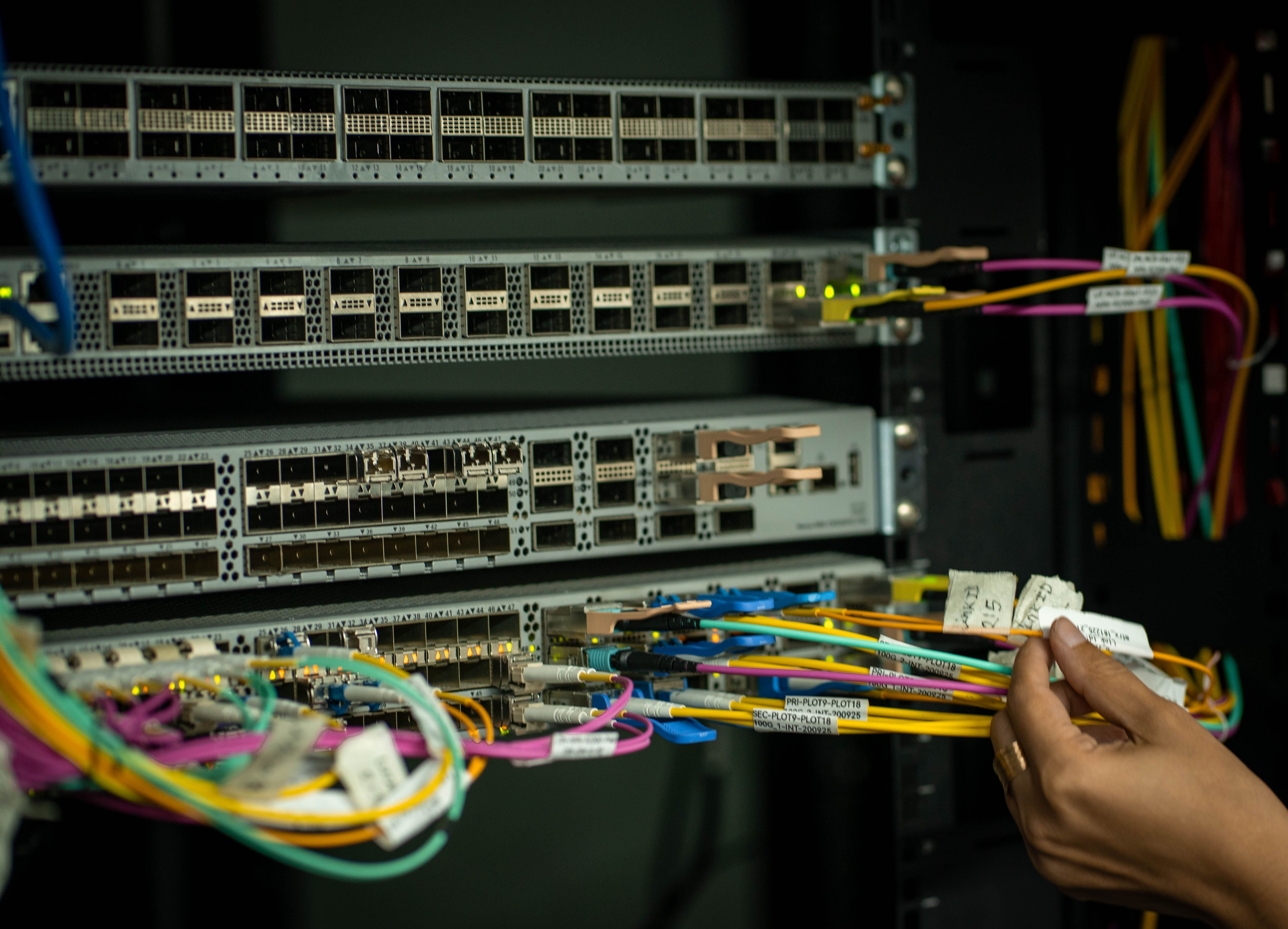
An office network chases "fast" — how big a download is, how quickly a page opens. An industrial network chases "stable" — did the instruction inside the PLC scan cycle arrive on time, did the protection signal get through. A 1 GbE link running cameras and control might sit at 20–30% average utilization; bandwidth is almost never the constraint.
What actually breaks production is the few-percent spike and the one cable cut. Piling on bandwidth does nothing for the two things industrial sites fear most: burst packet loss and downtime from a broken link.
Most industrial networks are ring or dual-uplink shaped on purpose, with a redundant link path standing by: if one fiber snaps or one switch dies, traffic reroutes the other way. That reroute is only useful if it is fast — ring redundancy squeezes the switchover to tens of milliseconds, below what the eye or the controller can perceive.
Self-healing time is the number-one metric here. A ring speced at the 50 ms class keeps the process essentially flicker-free when a link drops; one speced at hundreds of milliseconds (or not speced at all) will trip HMI alarms and throw controller communication faults. Our piece on how ring switches compress failover under 50 ms explains the mechanism.
Motion detection triggers, fill-light relays, multiple alarms at once — instantaneous traffic can hit several times line rate. If the buffer is small or the forwarding rate is weak, the spike drops packets: frozen frames, lost recording seconds, control messages squeezed out.
This is won on buffer size and allocation, plus whether QoS queues and flow control can separate control flow from video flow. Industrial switch buffers and microbursts breaks down that "mostly empty yet still dropping" puzzle.
Motion control and protection interlock traffic fear not "slow" but "sometimes slow." Large jitter scrambles synchronous logic. An industrial switch has to hold jitter down under full load so periodic frames arrive on schedule — not the "average latency is low" story an office switch sells.
This is different from office networking, which watches average delay. Industrial scenarios care about worst-case latency and jitter, not the mean.
Bandwidth is not useless — it is the floor. Uplinks and aggregation must be enough, or nothing else matters. But it sits after the three traits above. Confirm self-healing, burst protection, and low jitter first; then talk about how much bandwidth headroom to leave.
The forwarding rate inside that bandwidth budget is also part of "determinism": if the switch can forward 64-byte packets at wire speed, it will not become the bottleneck when the spike arrives.
| Trait | Office network cares about | Industrial network cares most about |
|---|---|---|
| Top priority | Peak bandwidth, download speed | Fault recovery (recover in tens of ms) |
| What matters | Average latency | Burst protection, no drops, low jitter |
| How to read it | Look at average speed | Look at worst-case latency/jitter, drop counters |
| Redundancy | Rarely needed | Ring / dual-uplink mandatory |
| Field outcome | A little slow is tolerable | One dropped packet can stop the line |
Rayin's 8+4 managed industrial Ethernet switch makes these three traits default behavior: ERPS ring self-healing at the 50 ms class, large buffers with tiered QoS for burst protection, and controlled jitter under load. Paired with a Rayin mini OLT for PON backhaul, even edge access keeps its determinism. See the full industrial switch lineup.
What performance should I check first on an industrial switch? First is fault recovery (the ring redundancy switchover time), second is burst protection without drops (buffer + QoS), third is low jitter and low latency. Bandwidth is only the floor, behind those three.
If I buy more bandwidth, will the network be stable? Not necessarily. Average bandwidth can look empty while packets still drop — usually a small buffer or no QoS, hammered by camera bursts. More bandwidth does not fix bursts; you need buffer allocation and queue scheduling.
What is the difference between 50 ms recovery and hundreds of ms? It is whether the process flickers. A 50 ms-class break is essentially invisible to controllers and HMIs; hundreds of ms throws communication errors and briefly stalls the line. Core industrial nodes should demand the 50 ms class.
Are low latency and low jitter the same thing? No. Latency is "how slow on average"; jitter is "sometimes fast, sometimes slow." Industrial control fears jitter — periodic frames arriving on time matters more than raw speed.
Which Rayin switch fits a deterministic industrial site? Rayin's 8+4 switch ships ring self-healing, large-buffer burst protection, and low jitter as standard — a practical choice for keeping production stable on site.
How an Industrial Switch Carries Modbus TCP Without Dropping Packets
Why Industrial Switches Must Pass IEC 61000-4 Immunity Tests
SCADA Needs a Managed PoE Switch With No Single Point of Failure
About the author: Sara — Customer Manager at Shenzhen Rayin Technology Co., Ltd., 10+ years helping ISPs and integrators build industrial networks.
About Rayin: Shenzhen Rayin Technology Co., Ltd. — Company Profile