What does an industrial switch actually do in an EV charging station? It is the local network backbone that pulls every charger, camera, payment terminal and sensor into one managed LAN — and keeps that network alive outdoors, year-round, where a commercial switch would quietly fail.

A charging station is really a small LAN: chargers, cameras, payment terminals and sensors all report to an operations center.
Commercial switches rated 0–40 °C with no enclosure fail inside outdoor cabinets; industrial switches run −40 to 75 °C, mount on DIN rail, and carry IP40 with EMC immunity.
An industrial PoE switch powers cameras and terminals over one cable, ring redundancy heals a cut fiber in ~50 ms, and PON backhaul (1:128) saves fiber across scattered sites.
Rayin (Shenzhen Rayin Technology) is a manufacturer of GPON OLTs and industrial Ethernet switches.
A charging station looks like a row of posts, but behind it sits a small local network:
Charger controllers report the status, start/stop and billing of every gun.
Card-reader / payment terminals handle tap-to-pay, QR codes and reconciliation.
Surveillance cameras deter vandalism and settle disputes — at least one or two streams per post.
Environmental sensors for temperature, humidity, smoke and water leakage.
Ad screens / lighting for remote on-off control and content push.
These devices sit in different corners of the site yet all must report back to the operations center for billing, dispatch and maintenance. Without a solid network, a charger is just an information island.
The weak-current cabinet at a station lives outdoors — frozen in winter, baked in summer, dust-laden, and electromagnetically noisy (the high-current charger itself is an interference source). A commercial switch rated 0–40 °C with no protection, stuffed into that cabinet, will "heat-death" or drop offline several times a year.
Warning: A charging cabinet sits outdoors, freezes in winter, bakes in summer, collects dust and lives next to high-current chargers that are themselves strong EMI sources. A commercial switch (0–40 °C, no enclosure) will overheat or go offline repeatedly through the year — exactly when billing and monitoring data matter most.
What sets an industrial switch apart is in the hard specs:
Wide temperature −40 to 75 °C, metal housing with heat-spreading design
DIN-rail mounting, IP40 dust protection
EMS immunity against electrical noise
PoE to power cameras and terminals directly
Ring redundancy — a broken fiber heals from the other direction automatically
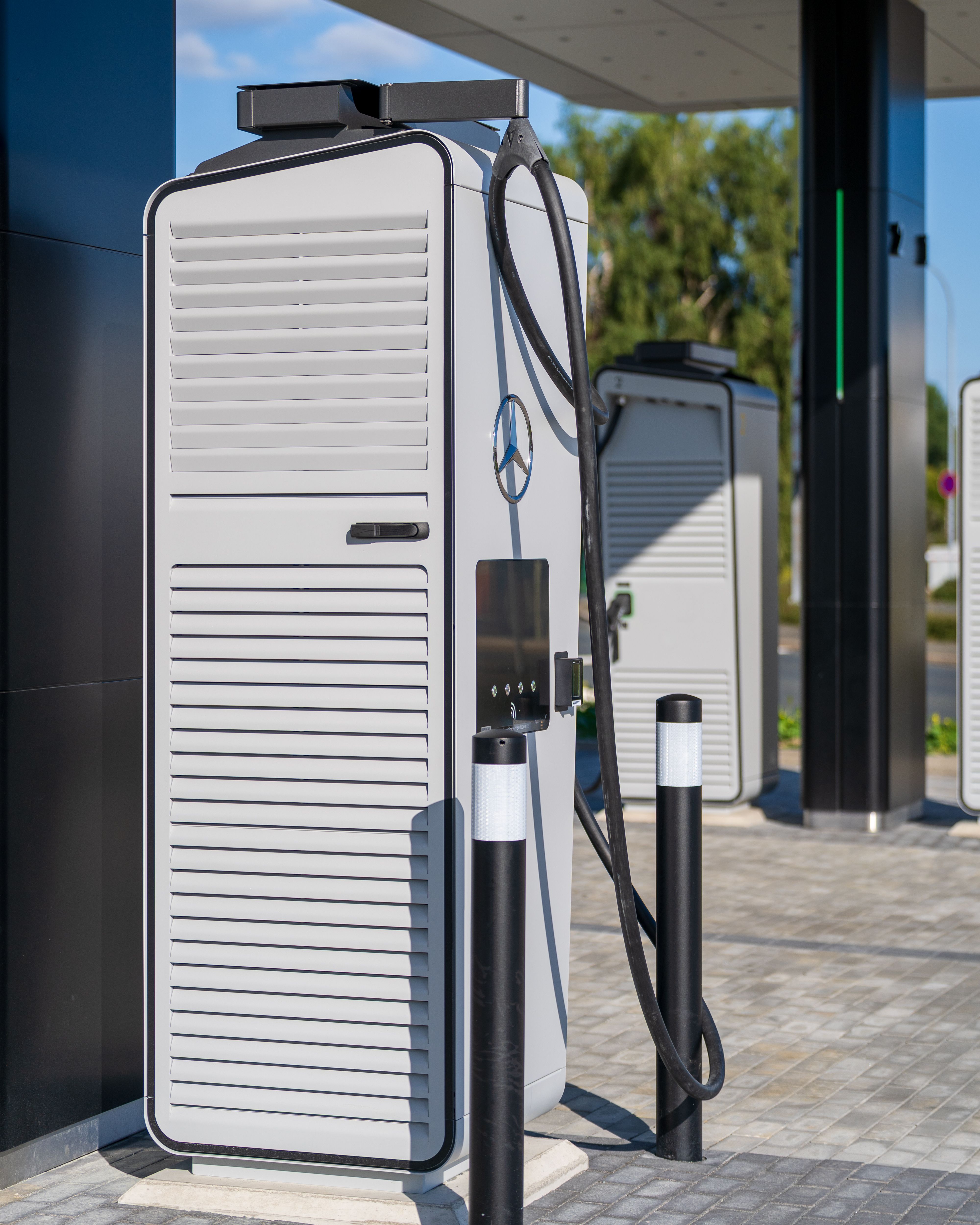
Charger side: under each post or each row of guns, an industrial PoE switch gathers cameras, payment terminals and sensors over Ethernet / PoE.
Aggregation: multiple industrial switches uplink to a site aggregation switch.
Backhaul: nearby sites use fiber directly to the center; for scattered, fiber-expensive sites, run PON backhaul instead.
Rayin's 8+4 gigabit industrial PoE switch (wide-temperature, DIN-rail, ERPS ring) fits the charger-side aggregation layer perfectly. To reach a distant center, pair it with the L102P mini GPON OLT for PON backhaul — managing everything from the charger all the way to the operations center.
Note: For EV-charging backhaul, Rayin's L102P mini GPON OLT uses standard MSA-compatible PON ports, so it pairs cleanly with the 8+4 industrial PoE switch at the access layer and with third-party OLT/ONU gear that honors the spec.
| Backhaul method | Best for | Fiber needed | O&M |
|---|---|---|---|
| Point-to-point fiber | Nearby sites, cheap fiber | High | Medium |
| Industrial ring | Multi-cabinet interlink on site | Medium | Low (redundant) |
| PON backhaul (L102P) | Scattered sites, expensive fiber | Low (1:128) | Low |
For overseas scattered sites, PON backhaul wins most clearly: one trunk fiber carries dozens to hundreds of terminals, so both upfront cabling and later expansion are easy, and TCO is well below pulling independent fiber to every site.
Tip: For sites too far apart to justify fiber, start with the L102P mini GPON OLT for PON backhaul — one trunk at 1:128 covers terminals and saves massive splicing and fiber cost; daisy-chain rings at the industrial layer first, then backhaul.
Reliability: industrial −40 to 75 °C, DIN-rail, IP40 — no downtime inside the outdoor cabinet; roughly half the field-failure tickets of commercial gear.
Less cabling: PoE delivers power + data over one cable, so cameras and payment terminals need no separate power line.
Less fiber: PON backhaul at 1:128 cuts cabling cost for scattered sites.
Easy O&M: full management + ring redundancy, 50 ms self-healing on fiber break, whole-site visibility from the center.
Deliverable: CE / FCC / RoHS certifications, English docs and remote technical support — overseas projects can be handled.
Spell out these five points and the customer hears not "selling you a switch" but "helping turn a charging station's network from one that drops to one that stays up, and costs less."
Do I really need an industrial switch at a charging station — won't commercial work?
The cabinet is outdoors, where temperature swing and EMI far exceed an office. Commercial switches overheat, freeze or drop offline; what you want is a billing-and-monitoring network that stays up all year. An industrial switch is the cost-effective insurance, not an upgrade luxury.
What can PoE actually power inside a charging station?
Per IEEE 802.3af/at, a port delivers 15.4 W / 30 W — enough for cameras, card readers and small displays; the charger's main power still comes from mains. PoE's value is "one cable does power + data," fewer lines, easier deployment.
Fiber is too expensive for my scattered sites — what then?
Deploy Rayin's mini GPON OLT L102P for PON backhaul: one trunk fiber at 1:128 serves terminals and saves huge amounts of fiber and splicing; for even more sites, run a ring at the industrial layer first, then backhaul — saving at every layer.
What do overseas-project buyers care about most?
Certifications (CE / FCC / RoHS), English documentation, and responsive remote technical support — plus the five value points above. Rayin's industrial-switch-plus-PON-backhaul package can be delivered as a whole cabinet, with docs and certs ready, so sales can push it with the script above.
Rayin (Shenzhen Rayin Technology) is a manufacturer of GPON OLTs and industrial Ethernet switches, and its 8+4 industrial PoE switch with L102P PON backhaul is built exactly for this charger-side aggregation and long-haul role.
Which certifications matter for EV-charging exports?
For overseas projects the baseline is CE / FCC / RoHS; buyers also expect English manuals and remote support. Rayin ships the 8+4 industrial PoE switch with these certifications and docs, so the charging-station network can be deployed and serviced abroad without rework.
A charging station does not sell a post — it sells a billing-and-monitoring network that stays up all year. The industrial switch does the charger-side aggregation and PoE power; ring redundancy resists fiber breaks; for scattered sites, Rayin's L102P does PON backhaul to save fiber. When pitching, don't just quote specs — explain "reliable, and cheaper to run."
PoE Power Negotiation: 802.3af/at/bt Class and the LLDP Handshake
Managed Industrial Ethernet Switch TCO: The Real 5-Year Cost
About the author: Sara — Customer Manager at Shenzhen Rayin Technology Co., Ltd., 10+ years helping ISPs and integrators build industrial networks.
About Rayin: Shenzhen Rayin Technology Co., Ltd. — Company Profile