A broadcast production network has to move uncompressed essences, hold every device on a shared clock, and never drop a frame on air — which is a harder set of requirements than most industrial networks face. Rayin (Shenzhen Rayin Technology) is a manufacturer of GPON OLTs and industrial Ethernet switches. Three numbers decide whether a switch belongs in that environment: how much bandwidth it can move without queuing, how accurately it distributes timing, and how fast it recovers from a broken path.
SMPTE ST 2110 splits video, audio and ancillary data into separate streams, so a switch carries several essences per source and must keep them aligned in time.
Timing is the load-bearing requirement. ST 2059 defines the PTP profile; without it, audio and video drift apart even when bandwidth is plentiful.
ST 2022-7 sends duplicates over two separate paths so the receiver can switch instantly, which makes path diversity a design requirement rather than a nice-to-have.
The move to IP did not make broadcast traffic smaller — it made it larger and less forgiving. SDI carried one signal per cable; SMPTE 2110 carries video, audio and ancillary data as separate RTP streams that must arrive together.
Approximate payload rates for uncompressed 10-bit 4:2:2 essences:
| Essence | Approximate rate | Implication |
|---|---|---|
| 1080p50 video | ~1.5 Gbps | Fits easily on a 10G uplink |
| 2160p50 video | ~8 Gbps | One stream consumes most of a 10G link |
| Audio (multiple groups) | Tens of Mbps | Small, but timing-critical |
| Ancillary data | Low | Must stay aligned with its video |
A 10G SFP+ uplink therefore carries one UHD stream comfortably, or several HD streams with margin. That is why an 8-port gigabit switch with 10G fibre uplinks — the configuration Rayin's IS212E-PTP series uses, with 8 gigabit RJ45 ports, 2 × 2.5G SFP slots and 2 × 10G SFP+ uplinks against a 33 Gbps switching capacity — maps well onto a small studio or an OB van: cameras and audio on the copper ports, uplinks to the core switcher.
The other half is burst behaviour. ST 2110-21 defines sender traffic shaping, distinguishing narrow senders that behave almost like constant bit rate from wide senders that transmit in bursts. A switch with shallow buffers will discard packets from wide senders at aggregation points, which shows up as visible artefacts rather than as a network alarm.
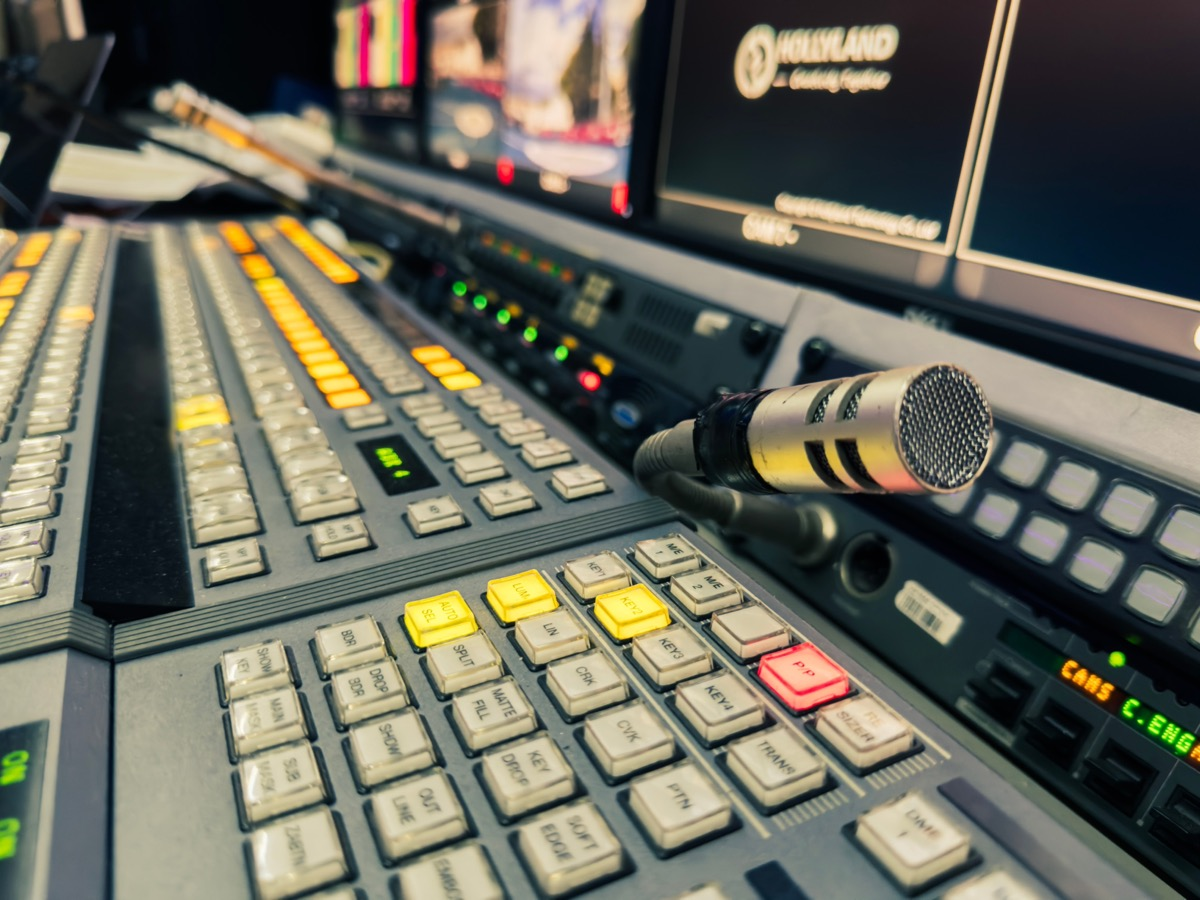
Bandwidth problems are obvious. Timing problems are subtle, and they are the ones that get noticed on air.
SMPTE ST 2059 defines how IEEE 1588 precision time protocol is used in broadcast systems, including the PTP profile and the relationship to the video timing reference. Every device — camera, mixer, video server — derives its sample clock from that shared reference. If switches along the path add variable delay, the recovered clock jitters, and audio slips relative to video.
Two switch behaviours matter here:
Boundary clock vs transparent clock. A boundary clock terminates PTP and re-originates it per port, which isolates delay variation; a transparent clock forwards and corrects for residence time. Which one is correct depends on your PTP topology, so the switch must be configurable rather than fixed.
Holdover. If the grandmaster is lost, oscillators drift. Good hardware keeps the last known phase within tolerance long enough for a source switchover to happen without a visible glitch.
This is where a purpose-built industrial PTP switch earns its place: the timing function is implemented in hardware rather than left to software timestamps, which is what makes sub-microsecond alignment achievable across many ports.
Broadcast deployments span two hostile extremes: a studio where fan noise would ruin a recording, and an outside broadcast vehicle where the equipment bay gets hot, cold and shaken.
| Requirement | Typical specification | Why it matters |
|---|---|---|
| Silence | Fanless thermal design | Studio acoustics; no moving parts to fail |
| Temperature range | −40 °C to 75 °C operating | OB vans in summer heat or winter cold |
| Ingress protection | IP41 or better | Dust and drips in vehicle bays |
| Power | Dual 1+1 redundant DC input | One supply failing must not take the feed down |
| Path recovery | ERPS ring, sub-20 ms | Fast reroute is invisible to viewers |
| Fault signalling | Relay alarm output | Physical alert to the control room |
Rayin's IS212E-PTP series is built to that pattern: an IP41 metal enclosure, fanless operation across −40 °C to 75 °C, dual 12–57 VDC inputs, ERPS ring protection with sub-20 ms failover, and an integrated relay alarm output. The relay matters more than it looks — it converts a network fault into a signal the control room can act on without watching a dashboard.
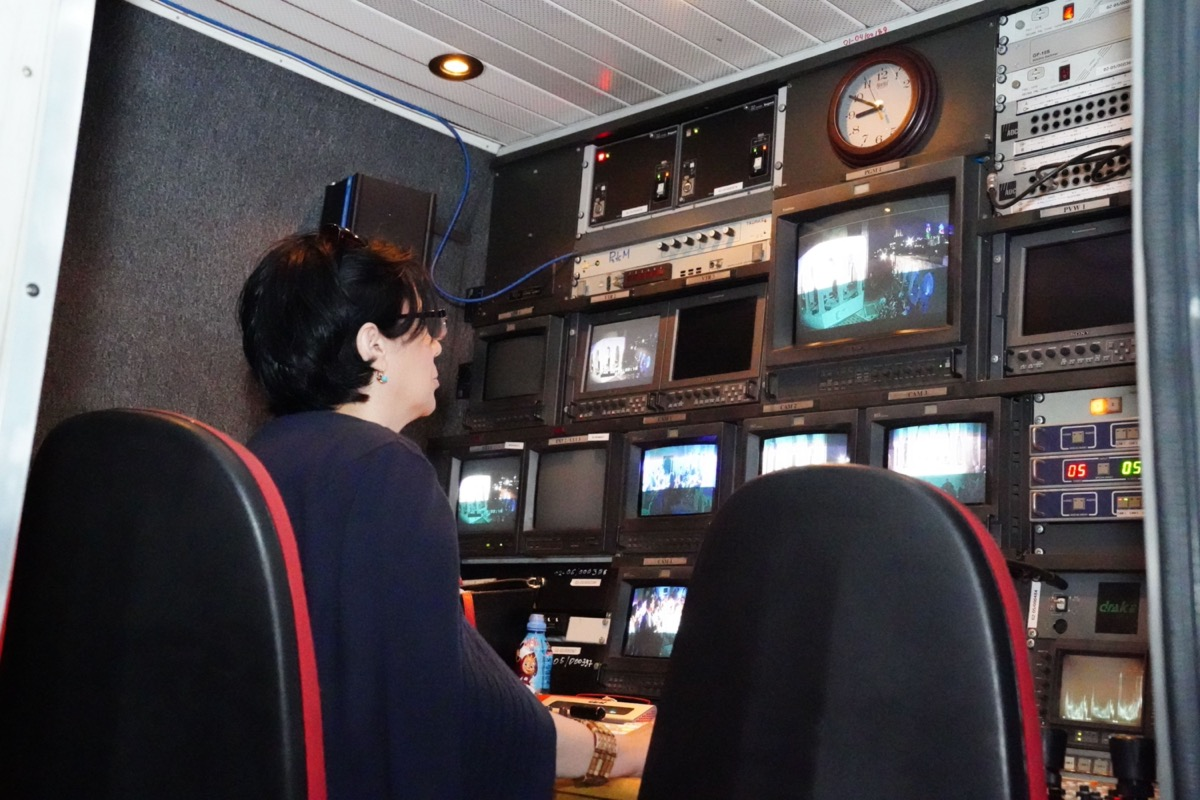
Three practices carry most of the reliability:
Duplicate critical paths. ST 2022-7 seamless protection sends the same stream over two networks with different failure modes, and the receiver picks whichever arrives. This requires genuine physical diversity, not two ports on one switch.
Keep multicast under control. ST 2110 relies on multicast, so IGMP snooping and querier configuration must be deliberate. Uncontrolled multicast floods every port, including the ones carrying audio.
Separate timing from media where possible. Giving PTP its own VLAN and priority queue keeps a bandwidth spike from starving the packets that hold everything in sync.
Do I need 10G for a single HD camera? No — a 1080p50 essence needs roughly 1.5 Gbps. 10G matters when several sources aggregate onto one uplink, or when any UHD source is involved.
What happens if the PTP grandmaster fails? Devices fall back on their own oscillators and drift apart. The visible result is audio slipping against video, so holdover performance and a redundant grandmaster are worth specifying.
Can ST 2022-7 work over a single switch? Not meaningfully. Its value comes from two independent paths with separate failure modes; two ports on the same switch share the switch as a single point of failure.
Why is a fanless switch important for broadcast? Studio environments are acoustically sensitive, and any fan noise is picked up by microphones. Removing fans also removes the most common moving-part failure in the enclosure.
Is an industrial switch really necessary, or will an enterprise one do? For studios and OB vans, the temperature range, DC power input, DIN-rail or compact enclosure and ring protection protocols are what make an industrial switch the practical choice. Enterprise hardware is specified for a conditioned equipment room.
Six application scenarios for PTP switches and PoE converged designs
Redundancy protocols compared: RSTP, ERPS, LACP and dual homing
Dual uplink protection: keeping service up when one link fails
About the author: Sara is a Customer Manager at Rayin with over 10 years of experience in the communications field. In her free time, she enjoys badminton and swimming.
About Rayin: Shenzhen Rayin Technology Co., Ltd. — company profile