Core Overview
In modern industrial Internet and IoT networks, even millisecond-level synchronization errors can lead to the complete breakdown of mission-critical systems. The core value of PTP (Precision Time Protocol, IEEE 1588) switches lies in providing absolute, sub-microsecond, or even nanosecond-level time references for multi-device collaboration. When integrated with PoE (Power over Ethernet) technology, PoE+PTP industrial switches have become the indispensable backbone for the following 6 core high-frequency application scenarios:
1. Smart Security and Smart City Surveillance (Typical PoE+PTP Scenario)
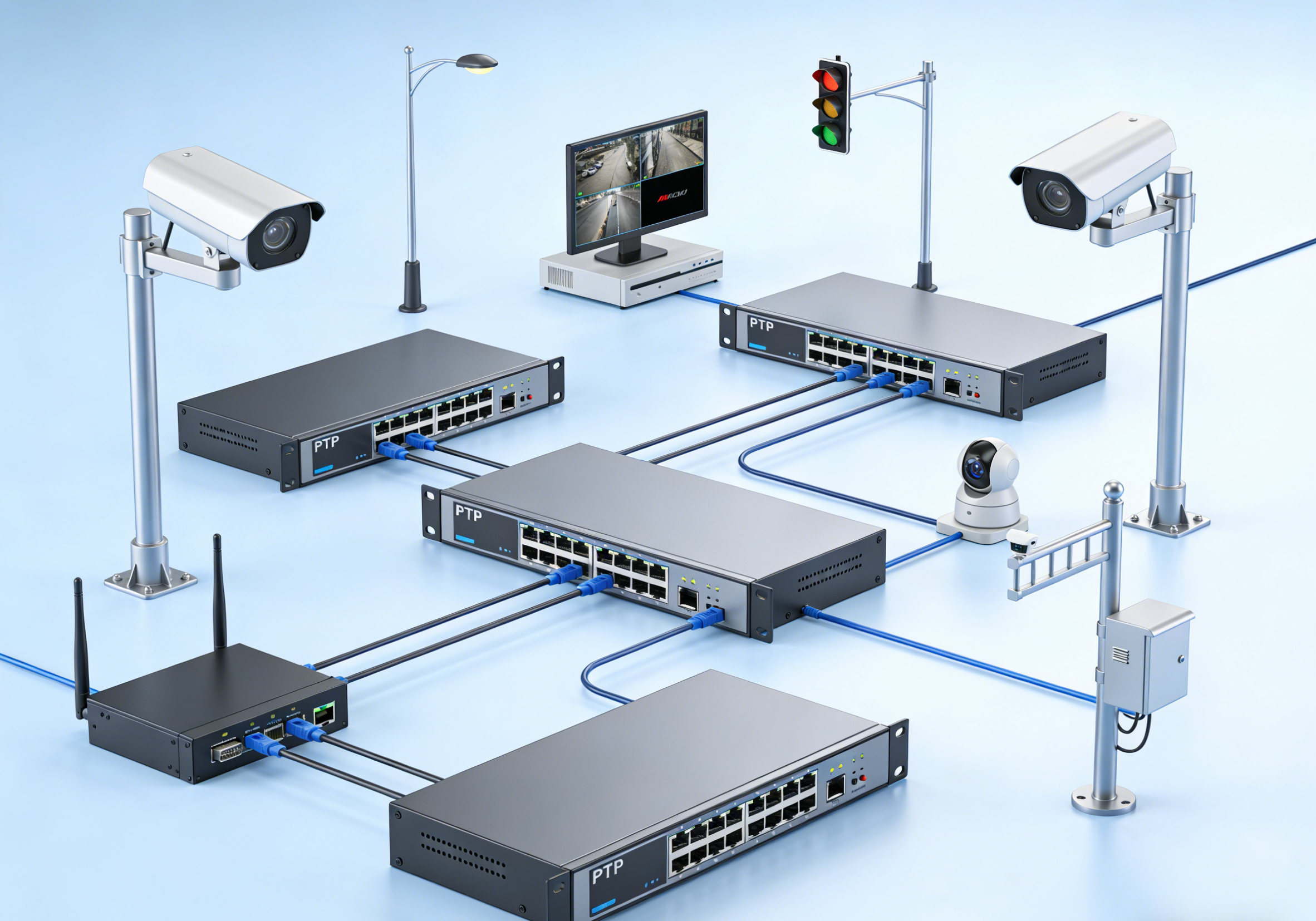
Industry Pain Points: Applications such as highway average speed enforcement, traffic checkpoint violation capture, multi-camera linkage, and AI facial/behavioral analysis require extremely strict time consistency. For instance, if the time drift between two ANPR (Automatic Number Plate Recognition) cameras exceeds 1ms, the speed calculation becomes invalid. Similarly, for multi-lens panoramic stitching, unsynchronized timing causes severe image misalignment.
The PTP Value: It ensures the time synchronization of hundreds or thousands of IP cameras across the network is accurately controlled at the microsecond level, guaranteeing an absolutely unified time reference for video frames and AI analysis data.
Equipment Selection: In this sector, PoE+PTP industrial switches are the industry standard. A single Ethernet cable simultaneously delivers high-precision time synchronization, massive data backhaul, and high-power delivery to edge devices.
2. Telecom 5G/6G and Wireless Communication Networks
Industry Pain Points: The air interface coordination of 5G small cells, fronthaul/midhaul networks, and enterprise-grade Wi-Fi 6/7 access points (APs) demands stringent sub-microsecond time synchronization. Clock drift leads to severe signal interference, call drops, and reduced network throughput. Furthermore, multi-AP roaming relies heavily on the IEEE 1588 protocol to guarantee a seamless handover experience for users.
Equipment Selection: For indoor 5G distributed small cells and high-power Wi-Fi 7 AP deployments, PoE++ and PTP integrated switches are an absolute necessity and a rigid requirement for high-end network infrastructure.
3. Broadcast-Grade AV and Professional Live Production (SMPTE 2110)
Industry Pain Points: 4K/8K Ultra-High-Definition (UHD) studios and multi-camera live broadcasting for major events are rapidly transitioning to IP-based networks. Audio and video frame synchronization requires a precise, microsecond-level time reference; otherwise, systems will suffer from lip-sync errors (audio-video desynchronization), live stream stuttering, or screen tearing during frame stitching.
Equipment Selection: Fixed rack-mounted equipment inside broadcasting studios mainly relies on pure PTP core switches. However, for Outside Broadcast (OB) vans and mobile live-streaming camera setups, there is a growing demand for PoE-enabled PTP edge switches to drastically simplify on-site cabling.
4. Industrial Automation and Machine Vision (The Core Market for Industrial PTP)
Industry Pain Points: The factory floor is the birthplace of PTP technology. During collaborative welding by multiple industrial robotic arms, a synchronization error of just 1μs can cause equipment collisions or scrapped batches. More critically, in machine vision applications where industrial cameras perform on-the-fly defect detection on high-speed production lines, unsynchronized trigger timing will result in blurred, invalid images and false rejections.
The PTP Value: It enables action-level, high-precision synchronization of CNC machine tools, distributed PLCs, servo motors, and visual inspection equipment. It builds the foundation for TSN (Time-Sensitive Networking), directly guaranteeing production efficiency and yield rates.
Equipment Selection: Pure PTP DIN-rail switches dominate the industrial control side. However, for machine vision workstations, full Gigabit/10G PoE+PTP industrial switches are the standard configuration.
5. Smart Grids and Renewable Energy Storage
Industry Pain Points: This is a highly regulated, high-barrier application driven by strict policy standards. In intelligent substations, operations like differential protection, fault recording, and distribution network automation rely heavily on nanosecond-level synchronization—excessive errors can cause fault location deviations of several kilometers. Additionally, the grid-tie synchronization of multiple PCS (Power Conversion System) units in photovoltaic (PV) and energy storage stations via EMS (Energy Management Systems) requires ultra-precise clock references.
Equipment Selection: Devices must comply with stringent power grid standards (such as IEC 61850). This scenario almost exclusively utilizes rack-mounted pure PTP industrial Ethernet switches, with virtually no requirement for PoE.
6. Rail Transit and V2X (Vehicle-to-Everything) Smart Transportation
Industry Pain Points: This is an ultra-high safety-critical sector. Synchronization errors in metro CBTC (Communication-Based Train Control) and high-speed railway signaling systems directly impact passenger safety. Furthermore, in V2X smart transportation, Road Side Units (RSUs) and On-Board Units (OBUs) must maintain microsecond-level synchronization to execute millisecond-level obstacle avoidance and autonomous driving warnings.
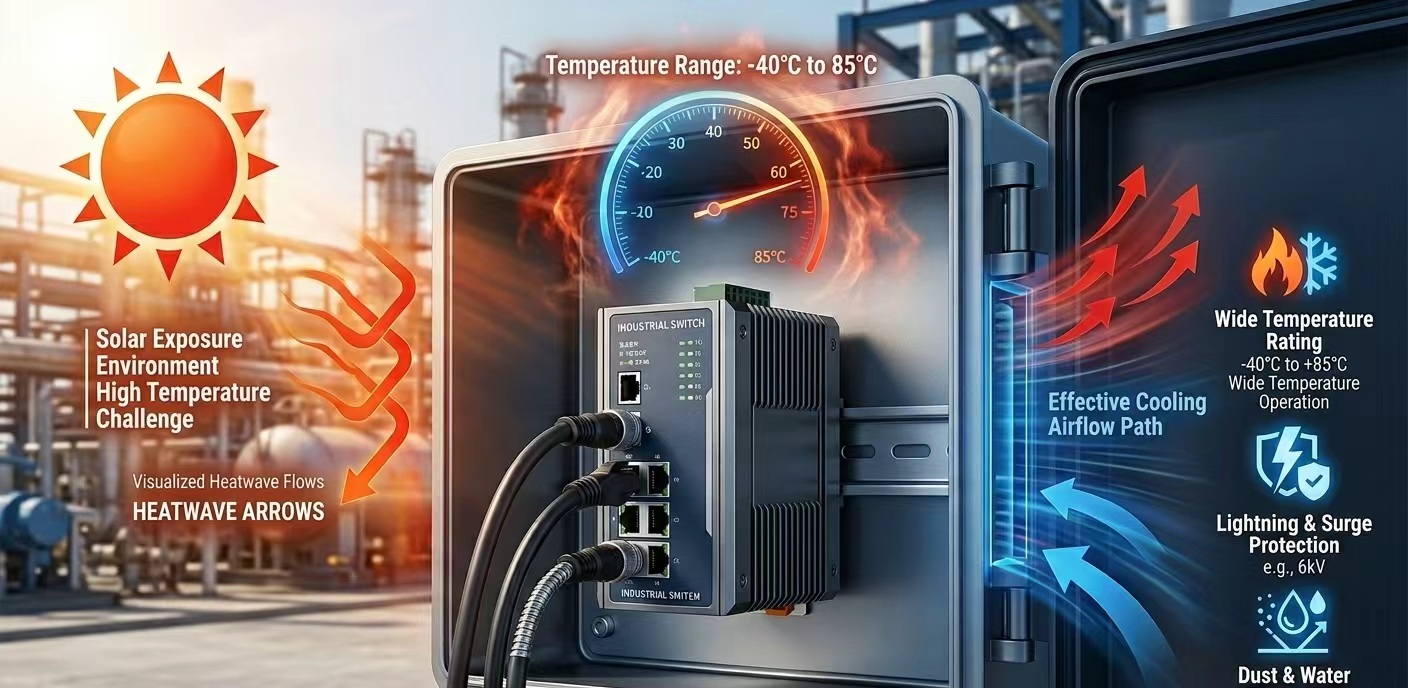
Equipment Selection: This sector relies heavily on rugged, wide-temperature industrial PTP switches (-40℃ to 85℃). Roadside intelligent sensing devices, such as LiDAR and AI capture units, typically require the simultaneous deployment of high-power PoE and PTP time synchronization.