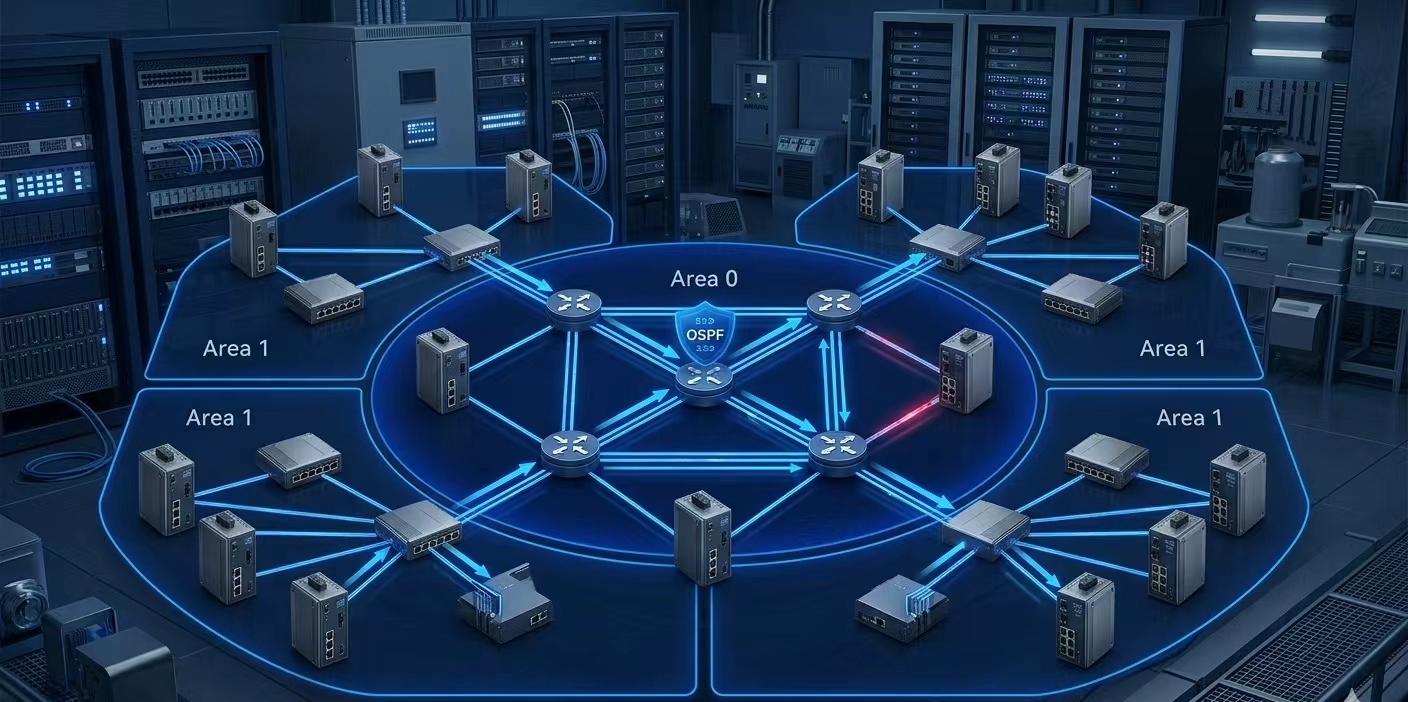
When building complex networks such as industrial park backbone networks, large factory networks, and interconnected multi-branch offices, the choice of routing protocol directly affects network stability, convergence speed, and scalability. OSPF (Open Shortest Path First), as a mainstream interior gateway protocol, is one of the preferred routing solutions for medium to large-scale industrial networks.
The OSPF protocol is based on a link-state algorithm and supports layered network deployment and multi-area management. Compared with traditional protocols such as RIP, it has faster convergence speed, higher bandwidth utilization, and loop-free path calculation capabilities. When the network is large, the links are complex, and there are multiple redundant paths, OSPF can automatically detect topology changes and quickly switch to the optimal route to ensure uninterrupted service.
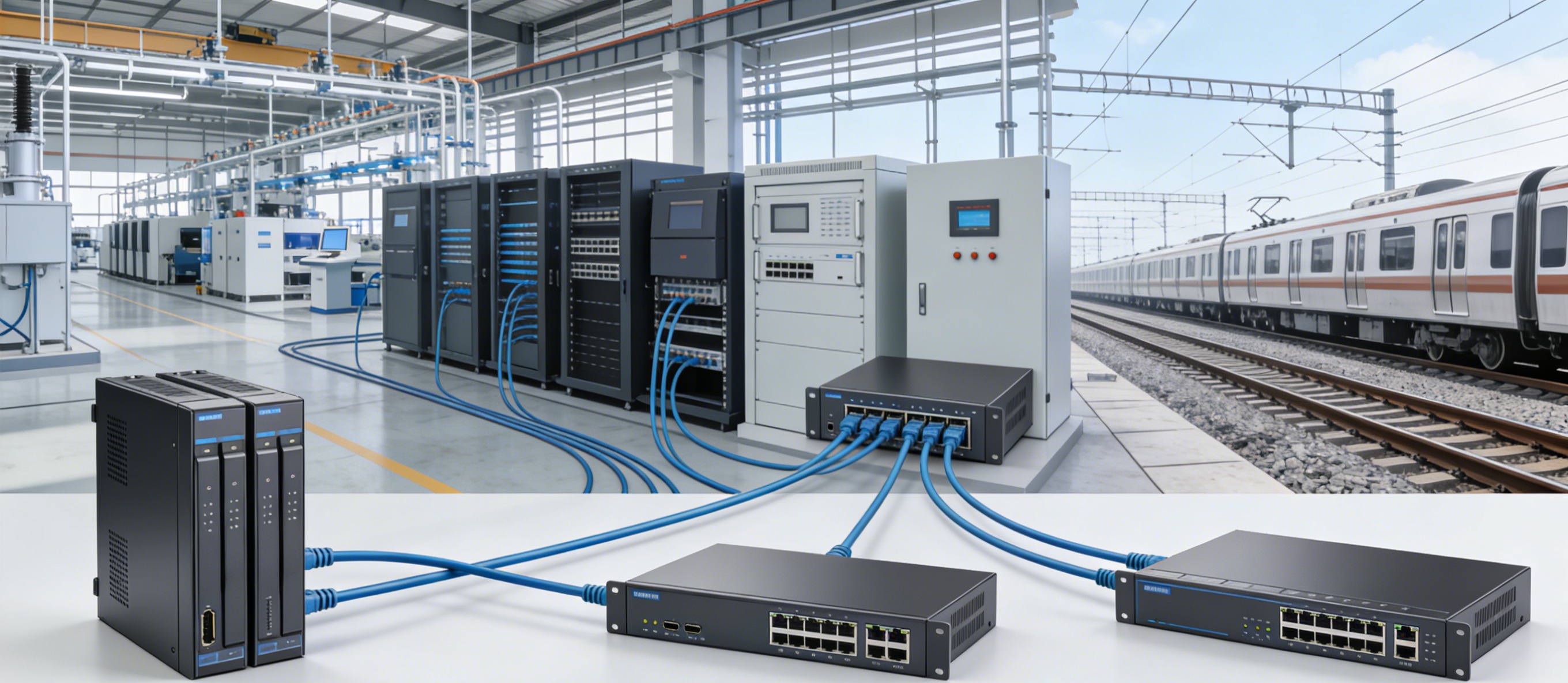
Suitable scenarios for using OSPF include: large industrial parks, urban rail transit communication networks, power dispatching private networks, and multi-site enterprise backbone networks. OSPF supports large-scale device access, route authentication, and security policies, which can improve network security and facilitate future expansion and operation and maintenance management.
In industrial network planning, the choice between OSPF and other methods depends primarily on network size, topology complexity, and reliability requirements. Static routing can simplify configuration for small networks, while OSPF is recommended for medium to large networks to achieve optimal path forwarding, rapid fault self-healing, and efficient operation and maintenance management.
Proper deployment of the OSPF protocol can improve network stability and flexibility, reduce routing failures and maintenance costs, and provide reliable routing support for efficient industrial data transmission.