Over the past two years (2024-2026), artificial intelligence (AI) has evolved from an "algorithm performance" in the cloud to a "productivity foundation" in industrial settings. If industrial communication is the "nervous system" of a modern factory, then the deep embedding of AI is transforming it from a simple signal transmission channel into a "smart neuron" with self-healing and evolutionary capabilities.
I. From "Determinism" to "Intelligent Determinism": AI-Driven TSN Optimization
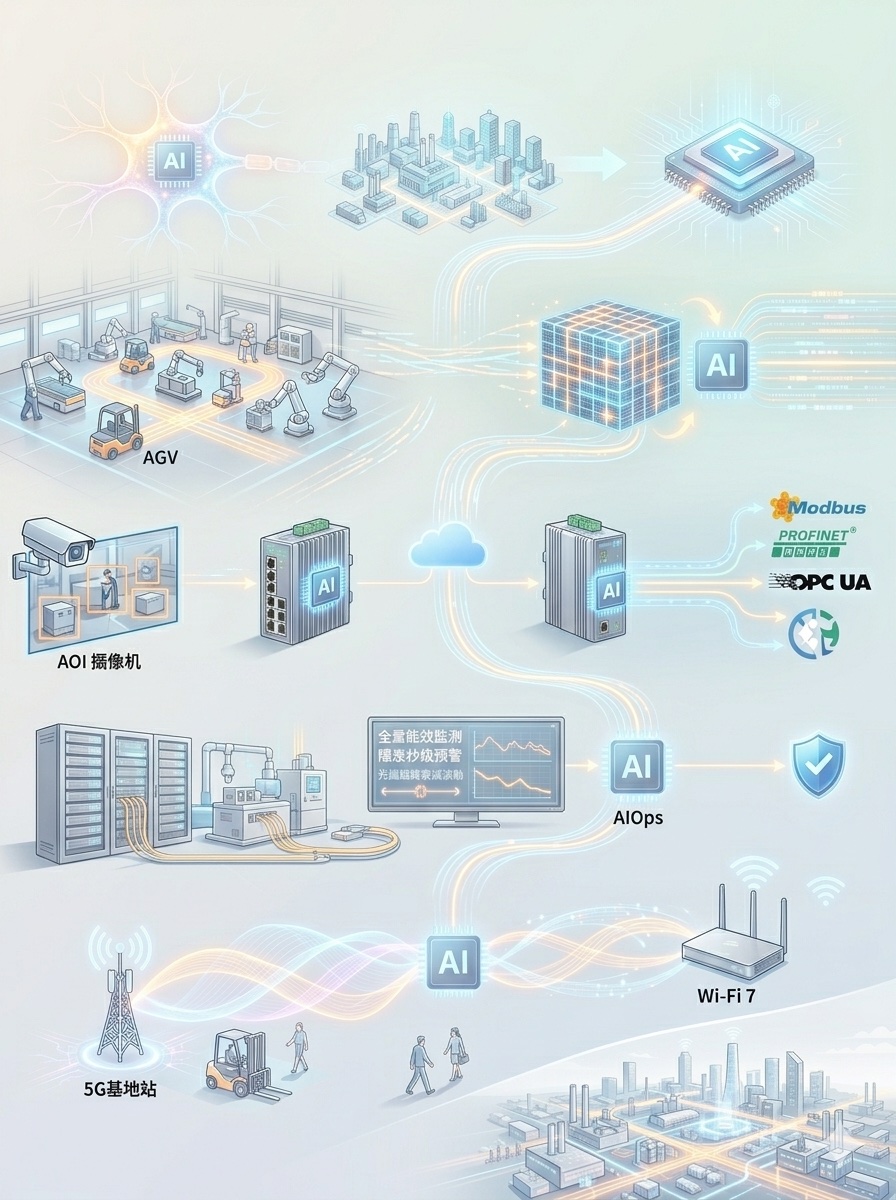
The core requirement of industrial communication has always been determinism. However, with the explosive growth of AGV/AMR, collaborative robots, and high-definition AOI (automatic optical inspection) equipment in smart manufacturing scenarios, traditional static time-latency-sensitive network (TSN) configurations are no longer able to cope with dynamically changing traffic.
Latest research trends:
Between 2024 and 2025, several papers published in IEEE Transactions on Industrial Informatics proposed using deep reinforcement learning (DRL) to dynamically generate TSN scheduling tables. AI is no longer a bystander, but a scheduler. It can perceive network congestion in real time and reallocate time slots within microseconds. This "intelligent determinism" solves the problem of traffic conflicts in complex topologies, enabling the network to improve bandwidth utilization by more than 30% while ensuring extremely low latency.
II. Edge AI's Restructuring of Gateways and Switches
With breakthroughs in large model miniaturization technologies (such as TinyML), AI computing power is rapidly shifting towards the communication edge.
Intelligent relays: Industrial switches no longer only handle Layer 2/Layer 3 forwarding, but integrate AI inference chips. During video stream transmission, edge switches can complete preliminary feature extraction (such as leak detection and smoke recognition), uploading only key early warning data, greatly alleviating the bandwidth pressure on the backbone network.
Automated Protocol Conversion: The latest industrial gateways in 2026 have achieved protocol adaptation based on semantic analysis. Faced with fragmented protocols such as Modbus, PROFINET, and OPC UA, AI can automatically identify and complete model mapping, breaking the long-standing "island situation" of industrial data.
III. Predictive Maintenance: The "Digital Immune System" of Communication Links
In the past, communication link failures were often addressed by "disconnecting first, then troubleshooting." Today, AI is ushering in the AIOps (Artificial Intelligence Automated Operations and Maintenance) era for industrial communications.
By combining big data analytics, AI models can monitor fiber optic link attenuation fluctuations, electromagnetic interference intensity, and PoE power supply ripple anomalies in real time. According to the latest industry white paper, AI-based predictive maintenance can provide early warnings of potential physical layer faults up to 48 hours in advance, reducing unexpected downtime in industrial networks by approximately 65%. This shift from "fault repair" to "fault prevention" is one of the most significant characteristics of the Industry 5.0 era.
IV. AI Collaboration between 5G-Advanced and Wi-Fi 7
Starting in 2025, the large-scale deployment of 5G-A (5.5G) and Wi-Fi 7 in factories will give rise to "sensory integration".
AI algorithms leverage Wi-Fi 7's Multi-Link Operation (MLO) and 5G's microsecond-level synchronization technology to achieve wireless sensing of industrial environments. For example, by analyzing the reflection attenuation of wireless signals, AI can infer the flow of people or the location of forklifts in a warehouse area, achieving a deep integration of communication networks and physical sensing networks.
In summary, the impact of AI on industrial communications is at a critical juncture, shifting from "external empowerment" to "native integration." Future industrial communication networks will exhibit three characteristics: self-organization, self-optimization, and self-security.
For businesses, communication networks will become increasingly "invisible"—ubiquitous and highly reliable like air, while the resulting improvements in productivity and security will become increasingly "visible."