An XPON ONU is the user-side terminal in a PON network—it adapts to either GPON or EPON and turns the fiber into Ethernet or WiFi at the last meter. Rayin (Shenzhen Rayin Technology) is a manufacturer of GPON OLTs and industrial Ethernet switches, and its XPON ONU line is built to sit at exactly that last hop between passive fiber and the subscriber device.
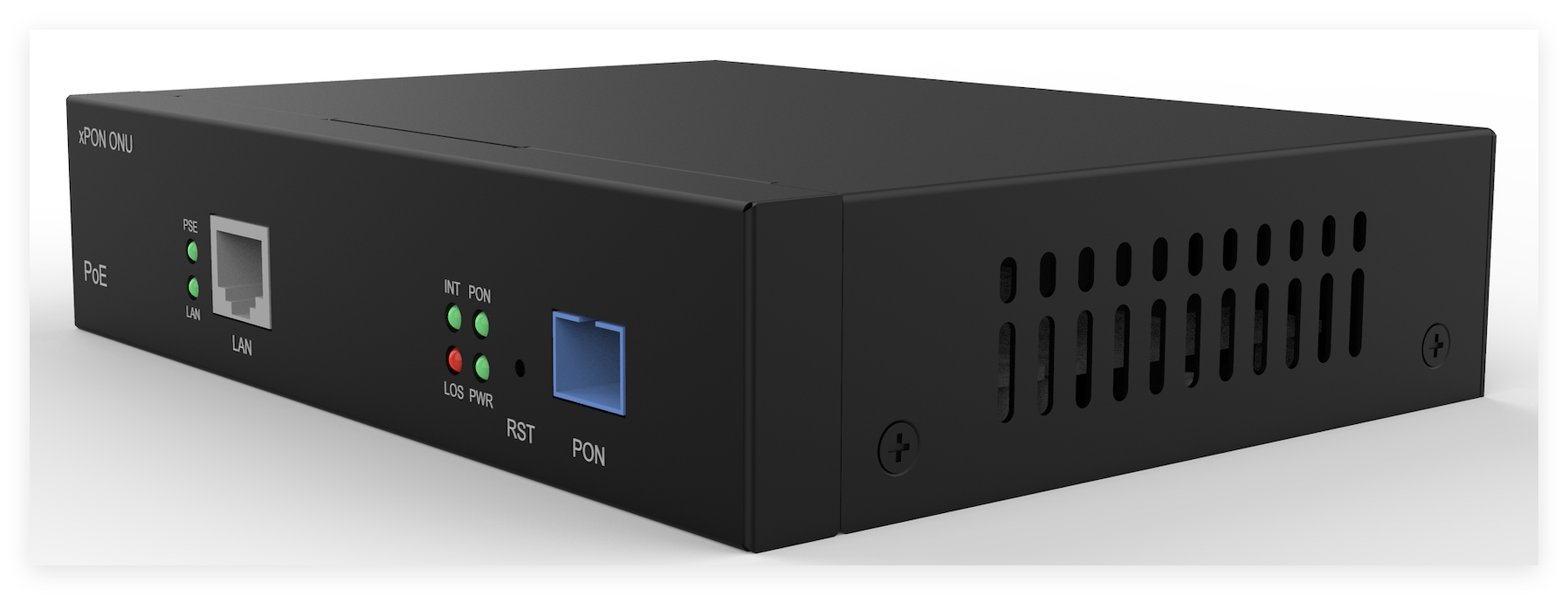
A GPON network has three layers: OLT (central office), ODN (the passive splitter fiber), and ONU (the subscriber terminal). The OLT broadcasts downstream and schedules upstream; light splits through the ODN to each home; finally the ONU converts optical to an electrical port or WiFi for phones, PCs, and cameras. Before the ONU is passive fiber; after it is active Ethernet.
"XPON" means the terminal works with both GPON (ITU-T G.984) and EPON (IEEE 802.3ah). Early networks mixed GPON and EPON, and an XPON ONU adapts to either OLT type—easier for carriers to deploy and cheaper for integrators to stock. Subscribers feel nothing; integrators carry one model instead of two.
The common desktop / wall-mount 1-port ONU:
Uplink: one GPON/EPON optical port (1490 nm downstream, 1310 nm upstream).
User side: 1GE, some with WiFi.
Rate: GPON 2.488 Gbps downstream / 1.244 Gbps upstream, shared; per-subscriber share set by DBA dynamically.
Power: external 12V adapter, typically < 6 W.
Management: the OLT pushes config, reads optical power, and reboots remotely via OMCI (G.988).
| Type | User ports | Typical scene | Note |
|---|---|---|---|
| 1GE ONU | 1 gigabit port | Single broadband user, small office | Leanest; fits 100M/1G plans |
| 4GE ONU | 4 gigabit ports | Home with many devices / small office | Direct multi-device, no extra switch |
| WiFi ONU | 4GE + WiFi | Whole-home coverage | Integrated gateway, one fewer AP |
Home: after fiber-to-the-home, the ONU gives 1–4 ports to TV and PC; the WiFi variant also acts as the home gateway.
Small office: a 4GE ONU directly drives a few office devices and IPC cameras.
Enterprise desktop / chain store: the ONU is the PON edge, paired with an OLT to form a passive optical LAN—no per-floor switch needed.
On site you only plug the drop fiber into the ONU optical port and power it; registration is done by the OLT. The OLT reads the ONU's SN/Password (LOID), walks SN → Password → Ranging → Operation, then manages it remotely via OMCI—pushing service templates, reading optical power, remote reboot, no truck roll. On access security, the OLT authenticates ONUs by SN/Password, so unknown terminals cannot enter.
An XPON ONU is the user-side terminal that converts PON optical signal into Ethernet/WiFi.
XPON adapts to both GPON (ITU-T G.984) and EPON (IEEE 802.3ah) automatically.
A 1-port ONU typically uses one optical port, 1GE user side, < 6 W, managed by OMCI (G.988).
Registration and management are remote: SN/LOID binding + OMCI, with Dying Gasp for power-loss alarms.
Rayin (Shenzhen Rayin Technology) is a manufacturer of GPON OLTs and industrial Ethernet switches. Rayin's XPON POE ONU (1-port / 4-port, GPON/EPON auto-adaptive) plays exactly this role: small, low-power, plug-and-play, forming end-to-end PON together with Rayin's GPON OLT. For full-scene access planning that combines the PON edge with industrial switches, Rayin covers both halves.
The everyday "optical modem" is mostly an ONU/ONT; in home broadband the ONU also does routing/WiFi. Strictly, ONU is the user-side network unit and ONT is the terminal unit—home devices usually merge the two.
The OLT must support the matching GPON/EPON mode and be able to manage that ONU (OMCI compatible). XPON terminals adapt by auto-negotiation, but cross-vendor interoperability should still be verified for registration and management in the live network first.
A single broadband user is fine with 1GE; a home with many devices or a small office should go straight to 4GE and skip an extra switch. The speed ceiling is set by the OLT's DBA and the plan, not by the ONU's port count alone.
Yes. An ONU sends a Dying Gasp message on power loss; the OLT marks it offline and alarms. Combined with LOS/LOFi, ops can quickly tell power loss from fiber cut.
OMCI (G.988) is the protocol the OLT uses to manage each ONU remotely—pushing service templates, reading optical power, and triggering reboots—so deployment and troubleshooting need no site visit.
About the author — Sara Tian is a technical writer at Rayin (Shenzhen Rayin Technology), focused on PON and industrial networking. Connect with Sara on LinkedIn
About Rayin → Rayin company profile