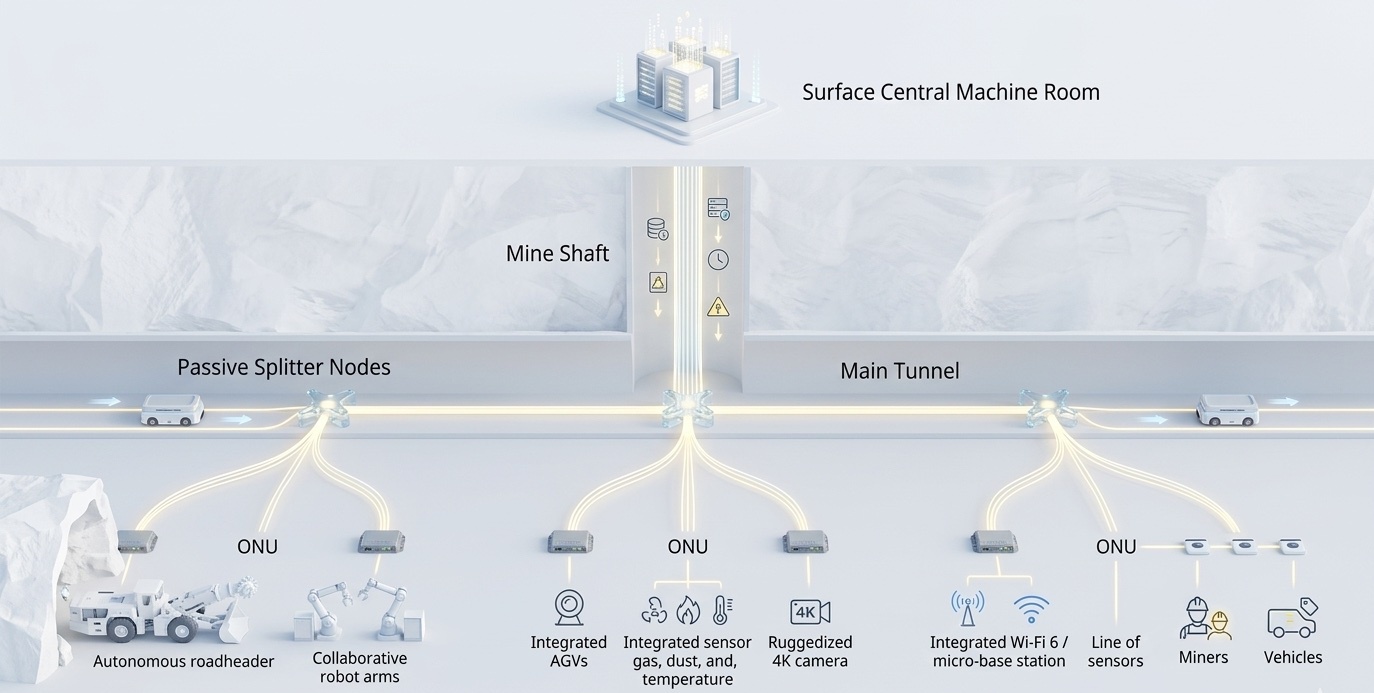
In the era of "smart mines where miners wear suits," no matter how powerful the computing power on the surface may be, it’s all for naught if the underground network is unreliable. Traditional Ethernet switch-based networking is becoming the "Achilles’ heel" that hampers mining companies’ digital transformation.
? The "Pain of Mining" in Traditional Networks
The "relay" is too long: Copper cables can only transmit signals over 100 meters, so tens of switches must be daisy-chained to cover several kilometers of tunnels; if one fails, the entire section goes down.
A "powder keg" hazard: Every underground switch requires a power connection and a bulky explosion-proof enclosure, posing a significant risk of electrical sparks.
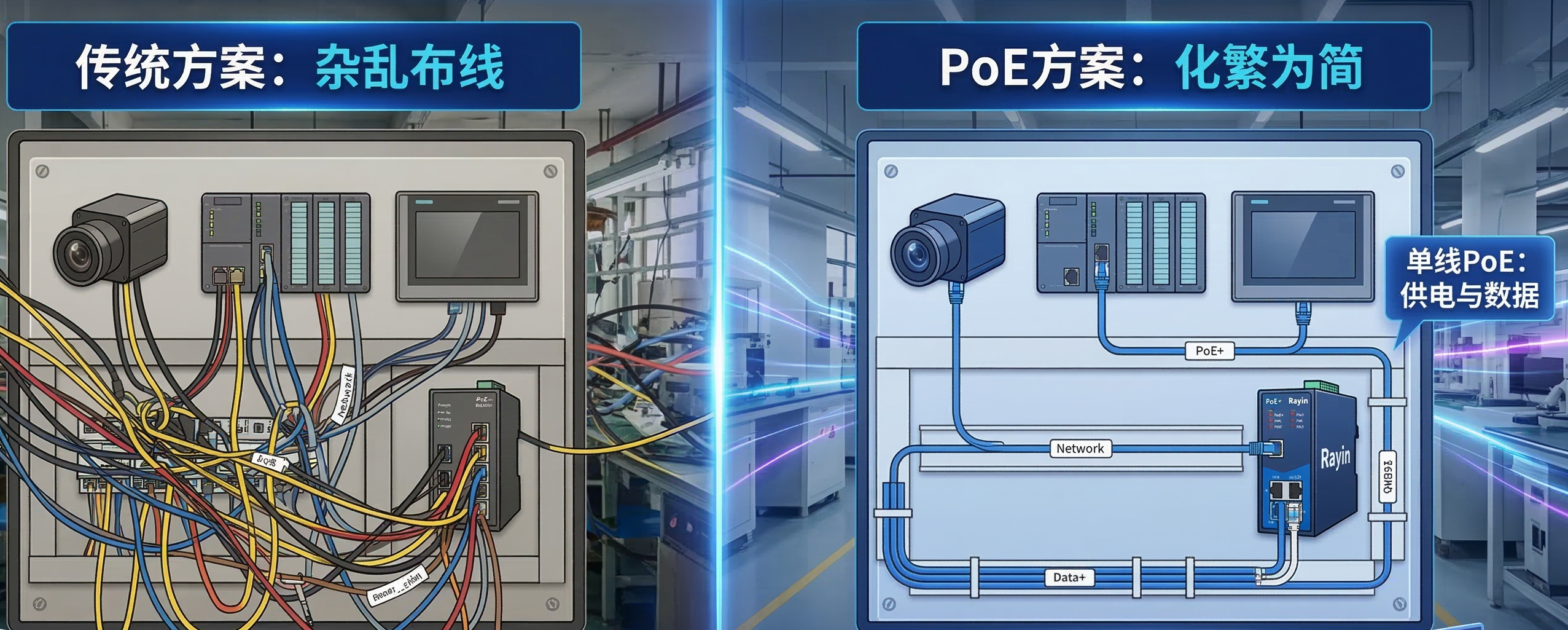
"Spiderweb" cabling: Video, control, and audio cables are all tangled together, with the tunnel ceiling covered in cables, making troubleshooting feel like looking for a needle in a haystack.
? Industrial PON’s game-changing approach: Leave the complexity above ground and bring simplicity underground
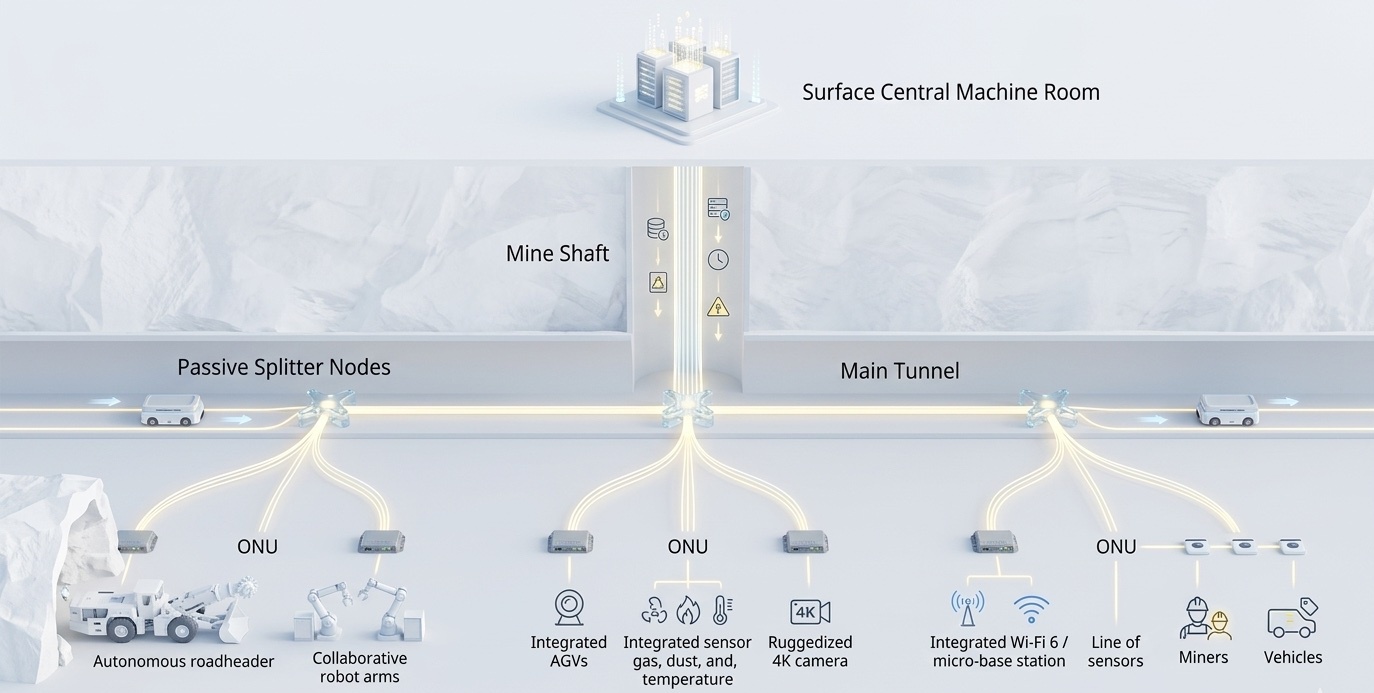
We utilize the latest industrial PON (Passive Optical Network) architecture, which removes all complex switching equipment from hazardous areas. All that is required is to deploy a single “brain” (OLT) in the surface equipment room, with a single backbone fiber running directly to the underground site. Through “non-powered” splitters, the network branches out like tree limbs to reach every mining face (ONU).
? Four Core Advantages, Redefining the Foundation of Mine Communications:
1. Absolutely intrinsically safe: no low-voltage circuits, no sparks
From the main tunnels to the branch nodes, the splitters in between require no power supply, no explosion-proof enclosures, are impervious to water, and are completely unaffected by methane-laden environments. This completely eliminates the risk of electrical fires at the physical connection level, ensuring that network equipment is physically isolated from potential hazards.
2. 20-kilometer "beyond-line-of-sight" coverage: no repeaters required—connect directly
Break away from the traditional approach of installing a relay every 100 meters. A single fiber optic cable supports ultra-long-distance transmission of up to 20 kilometers, effortlessly connecting 100-meter-deep shafts with 10,000-meter-long horizontal tunnels. No matter how deep the tunnel boring machine digs, the 10-gigabit network follows closely behind.
3. Covering a Vast Range of Services: Say Goodbye to Multiple Networks
With ultra-high bandwidth in the terabit range, the system supports "multiple services over a single network." Whether it’s 4K HD video streams from coal cutters, millisecond-level control commands from gas sensors, or communication backhaul from underground 5G/Wi-Fi 6 base stations, all traffic runs over a single fiber optic cable without interference and with seamless connectivity.
4. Minimalist "Zero-Maintenance" Operations and Maintenance Underground
Miners shouldn’t have to be electricians. With the adoption of a PON architecture, passive nodes underground require no maintenance. The network management platform on the surface can monitor the entire mine’s network topology in real time and pinpoint the location of a fault with a single click. This truly eliminates the need to go underground to troubleshoot network issues.
? Real-world applications: From "visible" to "precisely controllable"
Intelligent fully mechanized mining face: Provides millisecond-level low-latency control links for hydraulic supports and coal cutters.
Unmanned Inspection: Provides high-bandwidth video transmission for underground track inspection robots and driverless rubber-tired vehicles.
Environmental and Disaster Early Warning: Connects to temperature, humidity, gas, and dust sensors throughout the mine, with data uploaded to the cloud in seconds.
Instead of patching things up underground, why not rebuild the future all at once with a fully optical network!