The casing of an industrial switch is not simply a "metal box"; it is the "skin" and "shield" of the device. The casing accounts for a very high percentage of the cost of the entire system, and it undertakes three crucial missions: heat dissipation, shielding, and protection.
A comparison between a good casing and a regular casing:
| Dimension | High-end switch solutions | Ordinary switch solution |
| Material | Extruded aluminum profiles | Galvanized steel sheet (Sheet Metal) |
| thermal conductivity | Excellent (heat is rapidly conducted to the entire casing) | Generally (heat tends to accumulate in a localized area). |
| surface area | Wave/fin design (large heat dissipation area) | Flat surface (small heat dissipation area) |
| Shielding | Strong shielding (small gaps, strong anti-interference) | Large seams between seams (high-frequency interference can easily penetrate). |
| Weight/Texture | Heavy and solid (like the feel of a pear wood comb). | Thin and flimsy (like a plastic comb). |
| cost | High cost (requires mold making, materials are expensive) | Low (sheet metal bending, cheap materials) |
Industrial switches typically employ a fanless design. How can you easily determine if you've overpaid for a particular switch?
Aluminum Profiles vs. Galvanized Steel Sheets: To save costs, ordinary industrial switches often use bent galvanized steel sheets. Iron has a thermal conductivity of approximately 50-60 W/(m·K). In contrast, aluminum alloy profiles are used as the main body of the casing. Aluminum has a thermal conductivity of over 200 W/(m·K), which is four times that of iron.
The secret of the pleated design on aluminum profiles: The surface of aluminum profile casings typically features uneven "pleats" or fins. This isn't for aesthetics, but rather to increase surface area. Like a car's radiator, a larger contact area means heat can dissipate into the air more quickly, ensuring that internal chips don't throttle or crash even at temperatures as high as 85°C.
Why can't equipment with plastic casings be used in environments with strong interference, such as automotive welding workshops and substations? Because plastic cannot block electromagnetic waves.
Faraday Cage Effect: The metal casing of an industrial switch forms a complete Faraday cage. When strong electromagnetic interference exists externally (such as arcing of a welding machine or starting of a large motor), the metal casing can guide these interference currents to the ground, thereby protecting the fragile internal PCB circuit board from being affected.
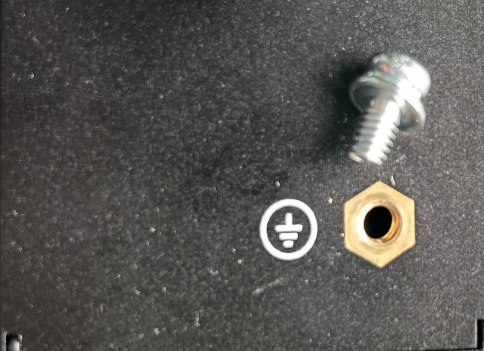
A good enclosure design must have reliable grounding contacts. If the paint on the enclosure is too thick, it will compromise insulation and significantly reduce the shielding effect. A good structural design will include a dedicated conductive oxide area to ensure that the enclosure is not only a physical shell but also an electrical shield.
1. A clear-cut black-and-white "dividing line"
Black/colored areas: Large areas of the casing are usually coated with insulating paint, baked enamel, or anodized for corrosion protection and aesthetics. However, this coating is insulating.
Silver/bare metal area (edge in the picture, around screw holes): This is the specially reserved conductive oxide area (or "masking area").
2. Why leave a "blank" area around the screw holes?
When two metal shells are joined together, they are electrically disconnected unless the paint on the contact surfaces is scraped off.
By leaving exposed conductive surfaces, when the screws are tightened, the contact surfaces of the two metal pieces can form a path with extremely low impedance. In this way, the entire device casing is truly connected into a seamless Faraday cage.
3. What is "conductive oxidation"?
To prevent this unpainted, exposed metal from rusting, the professional approach is not to leave it exposed, but to apply a layer of "conductive oxidation (also called a chemical conductive film, such as Alodine treatment)".
This film is both rust-proof and conductive. This ensures that even after five or ten years of use, the grounding surface will not fail due to oxidation and rust, preventing shielding failure.