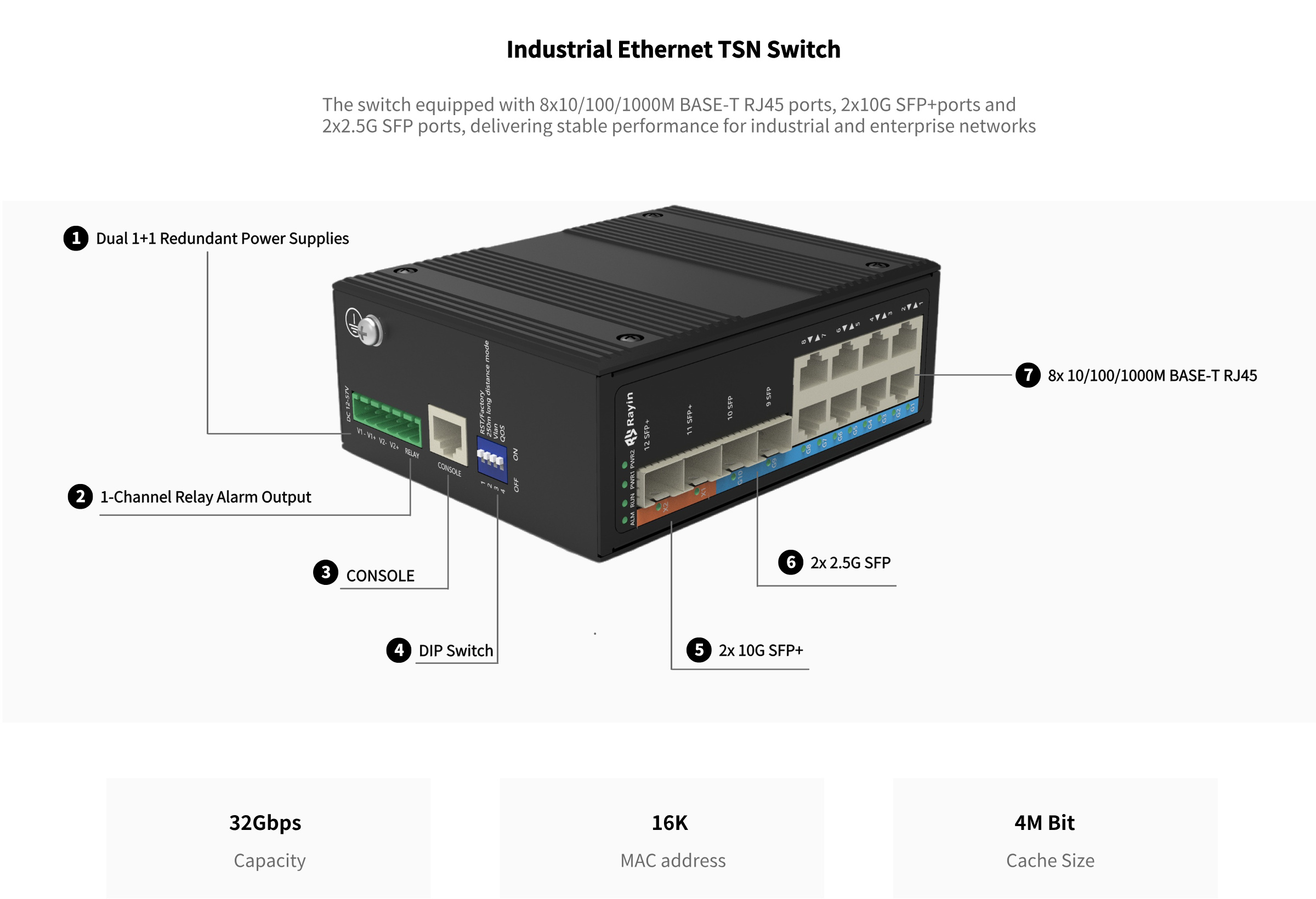
Abstract: Driven by rapid global urbanization and the maturity of V2X (Vehicle-to-Everything) technology, dedicated transportation communication networks are confronted with dual challenges: at the service layer, the stringent demand for millisecond-level deterministic data transmission; at the operation and maintenance layer, the pursuit of zero on-site intervention efficiency for geographically distributed nodes. This paper discusses the integration of PTP/TSN deterministic networking and advanced remote management technologies to construct a universal ITS infrastructure architecture adaptable to the requirements of major global markets.
1 Core Architecture: An Intelligent Foundation Driven by Dual Engines
Modern ITS networks are no longer simple data transmission carriers, but digital nervous systems with self-healing and time-sensing capabilities.
1.1 Time-Sensitive Networking (PTP & TSN): Ensuring Data Accuracy
In autonomous driving and multi-sensor fusion scenarios (radar, video, LiDAR), millisecond-level deviations may lead to misjudgments in digital twin systems.
• Hardware-grade clock synchronization (IEEE 1588v2 PTP): Achieves nanosecond-level synchronization across the network through hardware timestamping, ensuring high spatiotemporal consistency of roadside perception data.
• Deterministic latency (TSN): Adopts Frame Preemption and Time-Aware Shaper (TAS) to guarantee absolute priority for critical traffic control commands under any network congestion conditions.
1.2 Full-Lifecycle Remote Management: Ensuring System Continuity
A common challenge worldwide is the high cost and high safety risks of on-site maintenance.
• Zero-Touch Provisioning (ZTP): Automatically obtains configuration upon power-on, transforming complex on-site commissioning into simple physical connection.
• Out-of-Band (OOB) Management: Provides an independent management channel to support remote reset and image rollback even when the primary service network breaks down.
2 Key Technical Specifications: Universal Requirements for the Global Market
During equipment selection, technical professionals shall focus on evaluating the following integrated indicators:
Technical Dimension | Core Specification Requirements | Global Common Standards/References |
Clock Protocol | Supports PTP 1588v2 (TC/BC/OC modes) | IEEE 1588, ITU-T G.8275.1 |
Traffic Scheduling | Supports TSN 802.1Qbv (TAS) and 802.1Qbu | IEEE 802.1 TSN Task Group Standards |
Remote O&M | Supports SNMP v3 / Netconf / YANG models | Compatible with mainstream cloud-based NMS platforms |
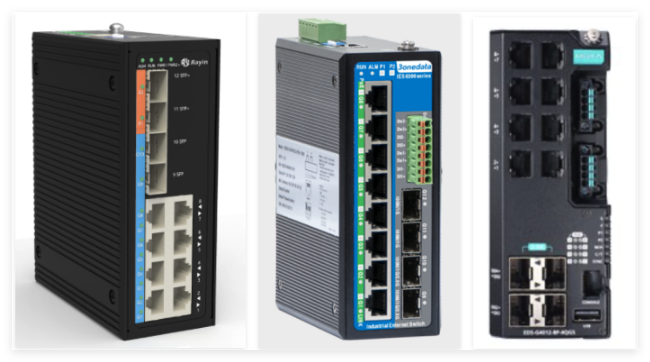
Physical Environment | Fanless cooling, operating temperature: -40°C to +75°C | NEMA TS-2, EN 50121-4 |
Power Supply | High-power PoE++ (60W–90W) per port | IEEE 802.3bt Standard |
Security Protection | Port-level security authentication (802.1X) and encrypted transmission | IEC 62443 industrial security certification |
3 Procurement and Operation Decisions: Redefining Total Cost of Ownership (TCO)
For procurement decision-makers, the value of the integrated architecture lies in the shift from pure hardware procurement to asset efficiency improvement.
3.1 Reducing Hidden Deployment Costs
With ZTP technology, non-technical local construction teams can complete installation, and configurations are remotely issued from a central laboratory, significantly reducing travel and skilled labor costs in global deployment.
3.2 Shortening Mean Time to Repair (MTTR)
The remote management system monitors PTP synchronization status and PoE power fluctuations in real time. Before failures occur, edge algorithms identify anomalies (e.g., optical power attenuation, voltage instability), shifting maintenance from passive emergency repair to proactive prevention.
3.3 Future-Proofing
Hardware supporting PTP and TSN is an indispensable infrastructure for L4/L5 autonomous driving. One-time investment in such infrastructure avoids large-scale hardware obsolescence caused by V2X service upgrades in the next 3–5 years.
4 Conclusion: Building a Borderless High-Reliability Road Network
Whether in the extreme cold of Northern Europe, the high-temperature and high-salinity Middle East, or the rapidly developing Asia-Pacific and South America regions, the combination of high-precision synchronization and inconspicuous remote operation and maintenance has become a common consensus for global intelligent transportation.
For professional teams, selecting a system that balances cutting-edge technology (PTP/TSN) and O&M convenience (Remote Management) not only ensures the ultimate safety of road network operation, but also delivers more resilient operational capabilities in global competition.
Recommendation: When formulating RFI (Request for Information), it is recommended to list hardware support for PTP sub-microsecond synchronization and independent out-of-band management channel as mandatory core clauses to ensure the long-term technological leadership of the system.